By Richard McKenna / October 28, 2026
 The Woman in Black
Directed by Herbert Wise
ITV (1989)
The year is 1989 and I am now a super cool punk rocker and art student. Okay, maybe not the “super cool” part, but I do have important punk rocker stuff to do (read: traipsing around in the drizzle, reading old comics, and feeling cold) and no access to TV listings, so I therefore foolishly miss out on the original transmission of The Woman in Black, British independent channel ITV’s adaptation of Susan Hill’s 1983 Gothic novel of the same name. I say foolishly because the adaptation was handled by Nigel Kneale, Britain’s most successful importer of scientifically-minded paranormality, doom, and anguish into the nation’s front rooms, who once again here creates something memorably uncomfortable.
The Woman in Black inhabits that odd region of British TV where extremely accomplished but vaguely oppressive location work blends with the kind of eeriness and unease that the generation who had lived through WWII were so gifted at putting on the screen. Born Herbert Weisz to a Jewish family in Vienna, director Herbert Wise had arrived in the UK in 1938 thanks to the Kindertransport scheme after the Nazis occupied Austria, and would certainly have witnessed his fair share of horrors, not least seeing his father packed off to Dachau. A stalwart of British TV who had worked on everything from Z-Cars (1962–1978) to Out of the Unknown (1965–1971) to Budgie (1971–1972) to Roald Dahl’s Tales of the Unexpected (1979-1988), Wise had shocked the nation in 1976 with his I, Claudius, an adaptation of Robert Graves’ novels that Time magazine included in its 2007 list of 100 Best TV Shows of All Time and that featured, in the words of The Telegraph, “unprecedented quantities of nudity, sex and violence,” including Caligula (John Hurt) cutting a fetus from his sister’s womb.
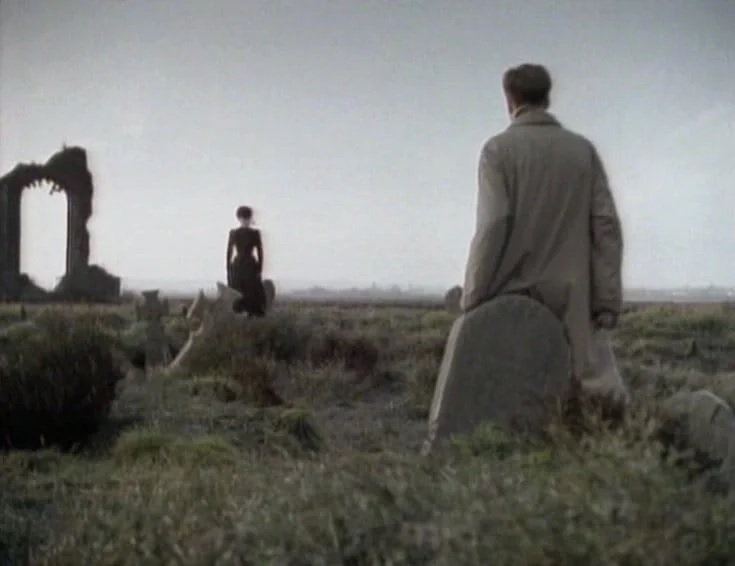
There’s no blood in The Woman in Black, but it’s plenty unnerving all the same. Though the story is a classic bit of British ghostery, it’s very much Kneale-ian in its affect, including a nod to one of his recurring themes, that of history and its unpleasantnesses being somehow recorded on the environment, only later to be unleashed in playback upon the unwary. The setup is that in 1925, upwardly mobile young London solicitor—that’s what we Brits call lawyers, because we’re sophisticated—Arthur Kidd is sent by his unpleasant but oddly evasive boss to prove his mettle by sorting out the affairs of a recently deceased lady, a reclusive widow, out in the wilds of the east coast of England. At the widow’s funeral, he sees a woman dressed in black who he presumes must be a mourner, but other people seem unnerved when he mentions her. The next day Kidd sets off to the widow’s house, a large pile with the inviting name of Eel Marsh that’s on a small island only accessible via the tidal causeway that appears at low tide. After a morning spent sorting through the widow’s papers, he decides to go for a walk through the family’s graveyard, situated on the land behind the house, and while there he once again sees the woman in black he saw at the funeral. I won’t spoil it by telling you the rest, but as you will imagine if you’re familiar with M.R. James or Nigel Kneale, things do not proceed in a particularly upbeat direction.
Very much a product of the televisual times in which it was made, at no point in the proceedings does The Woman in Black ever make you feel like you’re actually in the Edwardian age in which it’s set, and yet there is a strangely out-of-time feel to everything, beginning—for me—with male lead Adrian Rawlins, whose perfectly competent but vaguely naturalistic and overly-expressive performance is ever so slightly at odds with the period acting being practiced by the rest of the cast. This incongruence, though, lends itself to the atmosphere of unease that pervades the whole enterprise, marking Kidd out as someone already set apart from the safe, normal world.
Though the mood is restrained and tense throughout, it’s a gradual build, the first half feeling more like a low-budget adaptation of a minor H.G. Wells novel about social reform. Which only makes the single very frightening set piece even more shocking when it happens, and once it does, The Woman in Black becomes a cascade of misery that feels as confusing and upsetting as it does inevitable. The screenplay slowly ratchets up the feeling of dread, aided by what might be the most incredibly accurate evocation of British physical atmosphere ever committed to video, where the cold of the beds, the creaking and banging of the houses, and the endemic damp and weirdness are almost tangible. It’s so perfectly done that it pretty much single-handedly redeems the entire done-to-death concept of the ghost story.
As silly a concept—and word—as it might be, spookiness is something that I continue to crave even now as a wizened relic but find increasingly hard to locate in modern film and TV. That might be because I’m a look-back bore or that because of my age I’m just out of tune with current, and justified, ideas about what spookiness is. Because I’m sure it’s out there; it’s just that the cultural and physical spaces that I associate with spookiness probably don’t really exist anymore, at least not in the form that I knew them. Having grown up in a world without the levels of connectedness that are available today, I think it was much easier for us to feel spooked. Recently Backrooms (2026), for example, felt like a fairly successful attempt to take the genuine modern spookiness in the kind of stuff random anonymous people invent and circulate on the internet and put that into the format of a film, but for complete satisfaction, my decrepit British brain is unfortunately doomed to require an older form of spookiness, one which The Woman in Black provides in hearse-loads. Watch it and marvel.


