
Portraits of the Mushroom Cloud, 1946 – 1990

From the moment atomic weapons were first inflicted on the planet in 1945, the mushroom cloud became one of the defining motifs of the second half of the 20th century, assuming an almost supernatural significance that would only increase over time. It might seem paradoxical to speak about serendipity in the case of something that has been the cause of so much misery, but it’s hard to imagine nuclear weapons occupying quite the same space in the human race’s imagination had their effects not taken such a recognizable shape…
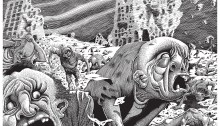

How Basil Wolverton Captured the Terrifying Imagery of the Biblical Apocalypse

By Greg Rozeboom

Born in 1909, Basil Wolverton was a successful American illustrator and cartoonist, admired within his industry and by its fans, yet little known to the general public. His drawings—the twisted shapes of spaghetti, meatballs, and mutation—may repel some, but they never fail to leave an impression, especially on the young. Wolverton was active between 1938 and 1974, and made a dent so deep that his style and influence were stamped into the underground comix scene of the ‘60s…

Between Authority and Resistance: The Terminator’s New Clothes

By Richard McKenna

Although apparently naked upon its arrival in the gloomy labyrinth of 1984, the Terminator is, of course, already wearing a costume: the layer of flesh and hair covering the titanium bones of its endoskeleton, which allows it to pass for human. Over the course of the film, though, the titular cybernetic assassin procures for itself two further and distinct outfits—-suits of fashionable armor associated with a wounded and dangerous type of modern masculinity…

Brothers in Harm: Common Threads in ‘The Terminator’ and the Myth of the Minotaur

By Andrew Wallace

While Terminator vs. Minotaur probably isn’t a viable franchise, I confess to an abiding love for these two myths, one classical and one modern. Each is horrific, almost repellent, yet also paradoxically fascinating and even erotic. As they’ve both been in my life for a long time, I’ve had the opportunity to notice similarities between the narratives and have identified several themes, images, and characteristics…

“Avenge Me!”: American Catharsis in 1980s Soviet Invasion Fantasies

Those of us who grew up in the 1980s probably gave a lot of thought (and worry) to the depictions of the aftermath of nuclear war. Films like The Day After and Testament in the US (1983), and Threads (1984) and When the Wind Blows (book, 1982; animated film, 1986) in the UK graphically portrayed the results of a global thermonuclear war. But what about the stories where the Soviets actually, physically invade the West using conventional forces?

Cover Your Eyes: Lynne Littman’s ‘Testament’, 1983

1983 was a pretty fertile year for fictional nuclear apocalypses in Western popular culture. 2019: After the Fall of New York, Endgame, Exterminators of the Year 3000, Stryker, and Le Dernier Combat were released in cinemas, while ABC’s The Day After and Britain’s BBC2 adaptation of 1961 dystopian novel The Old Men at the Zoo, updated to feature a nuclear attack on London, appeared on television…

Threnody in Black and Gold: ‘Twin Peaks: The Return’ as Cold War Historiography

By Michael Grasso

David Lynch and Mark Frost’s Twin Peaks: The Return arrived on television screens in the summer of 2017, promising to take fans of the original 1990-1991 ABC series back to the comfort of coffee and cherry pie at the Double-R Diner. What Lynch and Frost delivered was a sometimes bewildering 18-hour film that tested the limits of serialized television storytelling…

Designs for Radicalness: ‘Thrasher’ Magazine, March, 1986

The sport and art of skateboarding advanced rapidly in the 1980s, as did the subculture surrounding it. Though limited mostly to the contest circuit and empty pools and reservoirs (a Southern California discovery brought about by drought) in the previous decade, the invention of the polyurethane wheel and other advancements—wider, lighter, concaved decks with a pronounced kicktail—allowed skateboarders to go faster and develop new tricks…