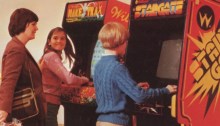
For Fun and Profit: Williams Electronics Ads, 1982
In 1982, video game cabinets could be found in almost every public business space that had room for them, and few sights were more prized by kids and young adults (provided quarters were handy)…
In 1982, video game cabinets could be found in almost every public business space that had room for them, and few sights were more prized by kids and young adults (provided quarters were handy)…
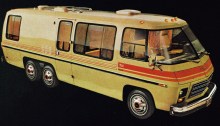
Combining the insular self-sufficiency of a lunar module with the intimidating bulk of a futuristic tank, the GMC Motorhome was the perfect attack vehicle for the leisure wars of the 1970s when—encouraged perhaps by the hermetic novelties of the space race—the recreational activities of the wealthiest fragment of the planet began to reflect a growing preoccupation with what we might call modular living…

The Instant City was an inflatable construction created in Northern Ibiza in 1971 to provide temporary accommodation for students attending the three-day 7th Congress of ICSID (International Council of Societies of Industrial Design). A series of brightly-colored, interconnected environments that housed up to 350 people at any one time…

The Big Kitchen, one of the country’s first large-scale food courts, opened in 1977 in the underground concourse of the World Trade Center complex. Conceived by famed restaurateur Joe Baum and designed by Philip George and Milton Glaser, the Big Kitchen comprised 8,000 square feet and offered, among other things…

This album full of spiritually-minded pop-funk was the product of a pair of teenage artists—vocalist/drummer Chris McDaniels (then 16 years of age) and elder brother, guitarist, producer, and arranger London McDaniels (all of 17 in 1978). The brothers had grown up in Southern California among the music business…

Four years after the release of Raymond Briggs’ When the Wind Blows, children in the British Isles were treated to another misleadingly cheerful-looking jaunt through a postlapsarian landscape in Graham Oakley’s 1986 book Henry’s Quest. I’ve spoken elsewhere about the extent to which the British culture of the 1970s and ’80s seemed determined to inculcate feelings of dread and hopelessness in young people, but with its superficially light-hearted tone, Henry’s Quest took a different approach…

Fate magazine, born in 1948 at the outset of both the Cold War and the flying saucer era, was a digest-sized periodical dedicated to the exploration of the paranormal. Fate leapt from the fecund imagination of Ray Palmer, the editor of Amazing Stories magazine for most of the 1940s…
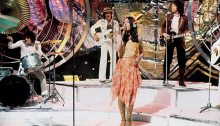
British folk-rockers Steeleye Span were arguably at the height of their powers and popularity in the mid-1970s, and their television series Electric Folk, broadcast on BBC2 in 1974 and 1975, shows exactly why. The series showcased the band’s blend of traditional British folk music and rock and roll to perfection, with the added bonus of being recorded in some of Britain’s oldest stately manors…

Released respectively in 1976 and 1980, these The Lord of the Rings and The Hobbit posters were sold in Athena, the British chain of art retail shops whose best-sellers—including Tennis Girl, also released in 1976, and Syd Brak’s 1982 Long Distance Kiss—were ubiquitous signifiers of the evolving aesthetic and sociological landscape in Britain…
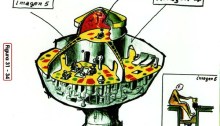
In the late ’70s and afterwards, UFOs hit the big time in pop culture with countless books about abduction experiences, major Hollywood motion pictures, and quickie B-movie documentaries. But before this turn into widespread exposure, ufology was largely a field defined by tightly-circulated, sometimes even self-published, written and photographic evidence…

