Michael Grasso / May 12, 2026
-
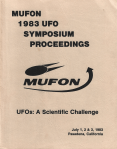
- Cover of the 1983 MUFON UFO Symposium Proceedings
-
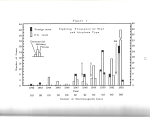
- Graphs accompanying Richard Haines’s presentation on early UFO era sightings.
-
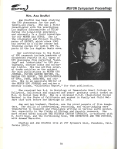
- The biography of Ann Druffel is typical of the amateur wing of MUFON’s membership.
-
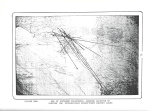
- Ann Druffel’s photocopied map of Southern California UFO “ley lines”
-
- Photo accompanying Alan C. Holt’s “UFO Propulsion: Pulsed Radiation and Crystalline Structure.”
-
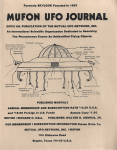
- Back inside cover of 1983 Symposium Proceedings: an ad for MUFON’s periodical UFO Journal.
-
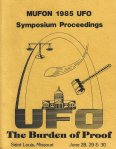
- The cover of the 1985 Symposium Proceedings with iconography of the law, government, and host city St. Louis.
-
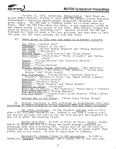
- Names for historical “UFO” sightings from George D. Fawcett‘s “What We Have Learned From UFO Repetitions.”
-
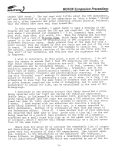
- Budd Hopkins and his description of working with abductee “Sandy.” He notes similarities to the Betty Andreasson case: “Neither of my witnesses at that time had heard of the Andreasson affair.”
-
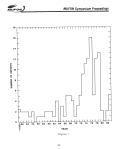
- Graph from David F. Webb’s presentation on abduction cases and hypnotism: notice the sharp peak after “the Fall 1973 wave of CE-III reports in the U.S.”
-
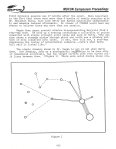
- Stanton Friedman’s defense of Betty Hill’s star map; he is jabbing back at Carl Sagan, whose 1980 series Cosmos debunked the Hill case in its twelfth episode, “Encyclopaedia Galactica.”
-
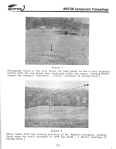
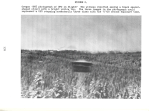
- Landing site of the Sturgell farm case in Jenkins, Missouri, from Ted Phillips’s symposium presentation “Physical Trace Landing Reports: The Case For UFOs.”
Object Name: MUFON 1983 and 1985 UFO Symposium Proceedings
Maker and Year: The Mutual UFO Network, Inc., 1983 and 1985
Object Type: Bound Proceedings Document
Image Source: The author
Description: (Michael Grasso)
The Mutual UFO Network was founded in 1969 as the Midwest UFO Network. In the famed UFO flap year of 1973, MUFON expanded its remit and changed its name (but not its acronym, conveniently). The organization hosted an annual regional symposium in Peoria, Illinois, which became an international event over the course of the 1970s. MUFON’s stylish symposium proceedings covers from the decade gave way to these slightly simpler, clip art-festooned covers in the 1980s.
The MUFON Symposium Proceedings contain introductory material from MUFON’s officers and full writeups of the presentations from each year’s convention. Amidst the mission statements from founder and longtime MUFON head Walter H. Andrus, Jr. are directories of all of MUFON’s worldwide officers, consultants, and regional directors: dozens upon dozens of names, many of whom possess PhDs. Andrus describes the positions available to MUFON members: “Consultant, State, Provincial, or National Director, Foreign Representative, State Section or Provincial Section Director, Field Investigator, Research Specialist, Amateur Radio Operator [noted elsewhere to be ‘operating weekly in the 10 and 40 meter amateur radio bands’], Astronomy, Field Investigator Trainee, Translator, and UFO News Clipping Servicee.” Andrus notes in the 1983 volume’s introduction: “In order that only qualified, competent, and sincere people may become involved, membership in MUFON is by invitation of one of the Directors previously named.”
That mix of ufological amateurs and professional scientists is borne out in the presentations in each document. The theme for 1983’s symposium, “UFOs: A Scientific Challenge,” drew detailed analysis of sightings and close encounters from throughout the quarter-century of the UFO era from all kinds of investigators at all levels of scientific rigor. Presenter biographies throw light on the sorts of people involved with MUFON. Psychology PhD Richard Haines offers a computer-aided statistical and anecdotal analysis of sightings from aircraft in the early years of the foo fighter and flying saucer phenomena, while nuclear physicist-turned-“entrepreneur” James M. Campbell examines the phenomenon of nearby UFOs interfering with vehicles’ electrical systems. Two papers on cattle mutilations take a point-counterpoint format: Amityville debunker Peter A. Jordan looks at the phenomenon as a collective delusional syndrome, while Andrus looks more closely at the physical mutilations committed (with graphic photos) in the original “Snippy” case and two others in Texas and Wisconsin.
On the more metaphysical and speculative side of the ’83 symposium, famed UFO investigator Allen Hynek had at this point begun to chafe at “extraterrestrial”-centric ufology on the rise since 1977’s Close Encounters of the Third Kind, (which Hynek appeared in and was a consultant on!), and the then-recent E.T. (1982). Hynek presented the symposium with the Valléean “ultraterrestrial” hypothesis, hinting that there is no “Cosmic Cape Canaveral” where saucers are physically berthed and being launched from. Physicist Alan Holt’s presentation on “UFO propulsion,” attributed to some quality of crystals under “pulsed radiation,” demonstrates that even hard scientists in ufology tend towards warrantless extrapolation. California ufologist Ann Druffel charts lines of UFO sightings along with “ancient Indian ritual sites” and finds a mass of suggestive UFO ley lines criss-crossing greater Los Angeles. The parapolitical and conspiratorial side of American ufology is explored by “former teacher and labor relations consultant” William L. Moore, who exposes a quarter century of government cover-ups of UFO intrusions—a “cosmic Watergate”—spinning out an early version of the “Majestic 12” myth featuring defense scientist and technocrat Vannevar Bush.
1985’s symposium focuses on “The Burden of Proof” that UFO researchers face, going deep into actual close encounters previewing the nascent, embryonic “abductee” myth cycle that would become so much more prominent with Whitley Streiber’s Communion in 1987. Budd Hopkins, whose Missing Time in 1981 enshrined much of the abduction narrative in the public mind, offers a centerpiece for this symposium with his “The Evidence Supporting UFO Abduction Reports,” which cites eyewitness ground testimony, physical signs of alien interference (scars on both the earth and on the bodies of abductees), and the “congruity of description” of the abduction experience among experiencers. Hopkins does not “want the reader to assume that I feel UFO abductions are crimes, or that these strange humanoid abductors are evil,” but rather wishes to acknowledge the traumatic aspect of humans being tagged with implants and released like wildlife.
Hopkins cites secondary witnesses from the scenes of the Pascagoula encounter, the Travis Walton case, and Betty and Barney Hill’s abduction to bolster their credibility, and mentions that contactee Betty Andreassen was one of the first to report a “probe” inserted in her eye. Aerospace engineer and Master’s degree recipient in “Future Studies” John F. Schuessler looks at physical evidence of medical harm, and ufologist John F. Webb (author of one of my favorite UFO texts, “1973: The Year of the Humanoids,” the flap that he cites as the beginning of the “abduction era”) examines the use of regressive hypnosis in UFO investigations and decides that the abduction phenomenon can and should be investigated and proven real without the use of hypnosis, which UFO skeptics and hypnotists alike had routinely cited as unreliable, tending to produce subconscious scenarios of fantasy rather than repressed memory.
The suggestive commonalities of these disparate MUFON presenters—many of them, especially the physical scientists, worked for the U.S. government or in the defense industry before becoming UFO researchers—does seem to buttress the now-common view that the entire world of postwar American ufology was a giant blind alley meant to distract from and obfuscate top secret U.S. military programs. Whether the members of MUFON were “useful idiots” for the Pentagon and Langley, eccentric semi-retired hobbyists with lots of time on their hands, or sincere fervent investigators into the paranormal is still an open question forty years after these symposia were held. Using some of these scientists’ own modes of statistical and anecdotal analysis, though, one can certainly come to some suggestive conclusions about who Cold War ufologists were, what professions and industries they represented, and why they gravitated (no pun intended) to the mysteries in the skies. Given the controversies that have enveloped some MUFON officers and members in the 21st century, the jury is certainly still out on whether “amateur” UFO organizations are still full of government agents provocateurs.


 We Are the Mutants