By J.E. Anckorn / October 30, 2026
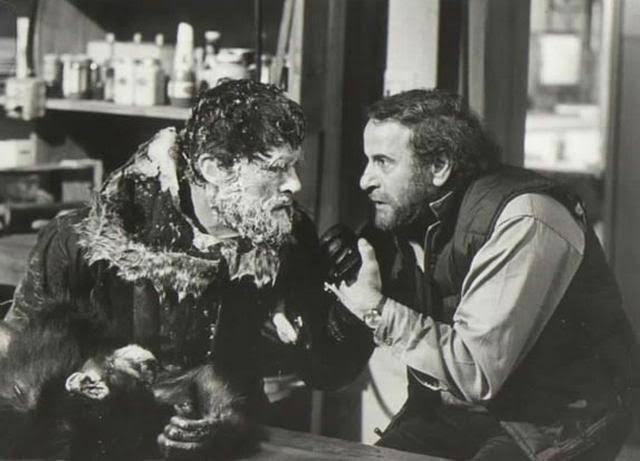 A Cold Night’s Death
Directed by Jerrold Freedman
ABC (1973)
When their predecessor Dr. Vogel is found frozen to death in an unlocked room of the Tower Mountain research station, scientists Robert Jones (Robert Culp) and Frank Enari (Eli Wallach) are dispatched to take over the research. Oh, and they have a chimp with them. This will become increasingly important in what is a movie of two deliciously bizarre halves.
We start off with an air of brooding claustrophobia. The Tower Mountain research station is well equipped to keep the scientists and their primate test subjects alive in the sub-zero storms, but it’s impressed upon us that they’re never more than a few hours from catastrophe. Drinking water comes from snow melt that must be collected in the deadly cold, and the generators that power the station seem to mysteriously fail of their own accord. Initially, Robert and Frank get on well, dividing the base’s chores and performing the experiments on the captive primates, but things soon unravel.
Robert had plenty of time to ponder on the fact that the death of Dr. Vogel doesn’t add up. Why was he found frozen to death when help was within reach? What to make of the cryptic cassette tape where he rants about visions of historical figures? And when Robert wakes in the night to the sounds of primate pandemonium and finds the generator turned off and temperatures plummeting, he begins to suspect foul play, as does the viewer. If we start this movie thinking inevitably of The Thing (1982), we’re soon led into territory covered by another claustrophobic masterpiece: Ridley Scott’s 1979 Alien.
Frank sees Robert creeping about at night and suspects him of being a company plant running the real experiment on his psyche. The viewer by this point suspects that the company is to blame too, and we’re unsure as to how reliable a narrator either of the scientists can possibly be. The dim industrial corridors and the palpable onscreen misery of the animal actors ramp up the air of paranoia and menace. It’s a tough watch if you don’t enjoy casual ’70s-era animal cruelty.
The relationship between the two scientists finally fractures, with Frank accusing Robert of running the experiment on him. He’s realized that whatever experiments are inflicted on the primate test subjects also happen to them. When the apes are subjected to endure freezing temperatures, stress, lack of food, and close confines, so do the human scientists testing them. Following a bitter argument, Robert is mysteriously locked outside the compound while collecting ice water and the two scientists finally reach the deadly climax. It’s tempting at this point to take the movie as an indictment of man’s inhumanity to man. We are merely the mirror of the savage, helpless apes being manipulated by forces we can’t understand, as vulnerable as them to the power of nature, both our own and the storms that rage outside. It’s a parable about the inhumanity of science in the name of progress, about our own nature as human beings, never truly escaping our animal origins no matter how we dress up savagery as progress.
But then there’s that ending.
Other reviewers have said that A Cold Night’s Death is an excellent movie so long as you ignore the last five minutes, but I’m here to tell you the opposite is true. Because anyone can make a movie about the machinations of an evil corporation or the follies of human nature, but it takes a Jerrold Freedman to make a movie where every twist and terror was the result of vengeful monkeys.
Frank realizes that the names of famous world leaders Vogel was ranting about on the remains of the tape were actually the names of the apes being used for the experiments. It was the monkeys all along! This is confirmed when he’s trapped in the same freezing room Vogel died in, and a sinister, blank-eyed ape face appears in the glass window. It’s a gloriously silly moment. Imagine watching all of Alien and then finding out in the last two minutes that it was all a plot orchestrated and carried out by Jonesy the cat.

Does it make any sense whatsoever? Not really, but none of these themes were particularly fresh to begin with, and if I’m alone in thinking this movie was vastly improved by the addition of the mendacious monkeys, then at least I’m alone on a freezing research station being menaced by a macaque, which is how I’d like to go. Those damned dirty apes.


