
The International Radiation Symbol, 1946
The International Radiation Symbol or Ionizing Radiation Trefoil Warning Symbol was created at the University of California Berkeley Radiation Laboratory in 1946…
The International Radiation Symbol or Ionizing Radiation Trefoil Warning Symbol was created at the University of California Berkeley Radiation Laboratory in 1946…

“Brace yourself for an exciting, realistic sight and sound journey into another world…” Such was the promise emblazoned on the star-spangled blue packaging of the AudiSee titles, a series of “stereo dramatizations,” science-fiction audiobooks on cassette, each accompanied by a glossy, full-color illustrated booklet…
This advertisement for the 3rd Festival for Mind Body Spirit appeared in Alpha magazine (subtitled “Probes the Paranormal”) in 1979. Its promise of “Psychic phenomena, UFO’s [sic], Earth Mysteries and more” was a slight shift in emphasis from the event’s official poster…

In 1989 veteran illustrator and concept designer Ralph McQuarrie was commissioned to produce a series of illustrations for Isaac Asimov’s Robot Visions, a collection of essays and short stories and a companion volume to Asimov’s 1986 short story collection Robot Dreams…

After a partial nuclear meltdown occurred at the Three Mile Island nuclear power plant only days before the release of a 1979 film discussing just that possibility, the term “China Syndrome”—used by nuclear power experts to describe a hypothetical scenario in which an overheating reactor core melted its way to the other side of the planet—quickly passed into common usage…
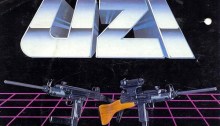
Immortalized when one appeared in the hands of U.S. Secret Service Special Agent Robert Wanko during John Hinckley Jr.’s 1981 attempt to assassinate President Reagan, the Uzi—a submachine gun designed by German-born Israeli Uziel Gal, from whom it took its name—was sold to more law enforcement and military markets than any other weapon in its class…

In the early 1980s, the spectrum of opinions regarding life after a nuclear exchange ranged from that held by the scientific establishment—at best a severely compromised environment, and at worst the extinction of the human race—to another, less pessimistic view that sensed an opportunity for a mankind neutered by the shackles of modern society to return to the more unambiguous, manly, uncompromised moral certainties of a simpler age…
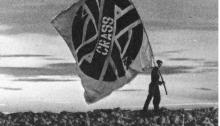
This striking logo, which blends symbols of perceived authority including the Christian cross, the swastika, the Union Jack and the ouroboros, was the logo of anarchist art-punk collective Crass…

Edited by Yorkshireman Dez Skinn—the self-styled “British Stan Lee”—and published by his company Quality Communications, Warrior was a 26-issue British comic featuring work by both well-known and up-and-coming artists and writers…

This 1976 promotional poster for Rainer beer, entitled “Barbeerian [sic] conquers Sasquatch” and showing a muscular warrior serving the mythical creature the beverage, demonstrates that high fantasy and cryptozoological tropes had penetrated the popular culture of the second half of the 20th century to such an extent that they could be reliably mined for mainstream parody…

