By K.E. Roberts / May 11, 2026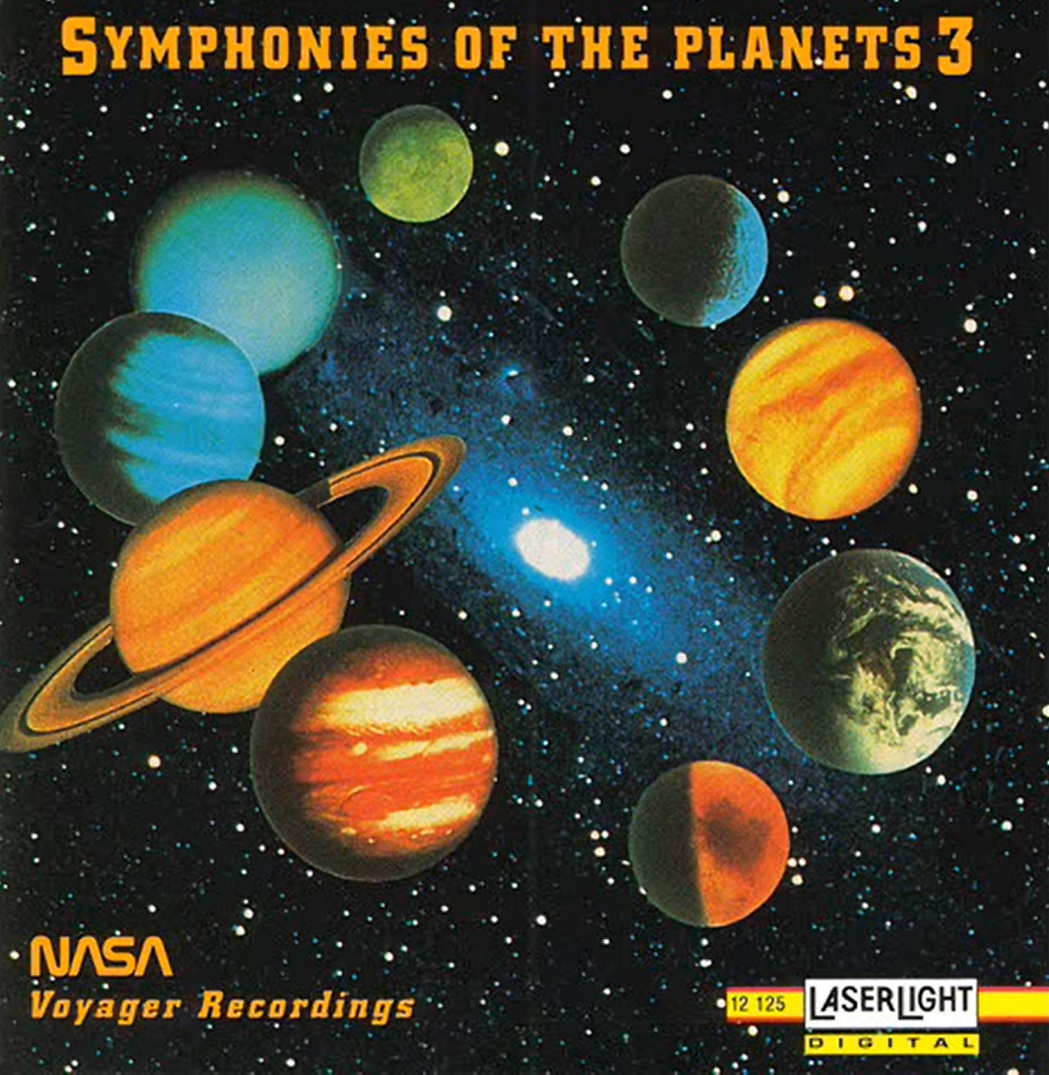
In 1992, an entity called Brain/Mind Research released a series of five CDs, Symphonies of the Planets: NASA Voyager Recordings, that purported to be
created from original Voyager recordings of the electromagnetic ‘voices’ of the planets and moons in our Solar System… The complex interactions of the cosmic plasma of the universe, charged electromagnetic particles from the solar wind, planetary magnetosphere, rings and moons create vibration ‘soundscapes’ which are at once utterly alien and deeply familiar to the human ear.
I first heard the recordings in the early 2010s and was fairly mesmerized, and at first kind of believed, or wanted to believe, that the sounds actually came from the most famous space probes in the universe. The truth, alas, is not as starry—but it’s still a lot of fun.
Brain/Mind Research was a label created by Dr. Jeffrey D. Thompson (his doctorate is in chiropractic), a musician and the founder and director of Carlsbad, California’s Center for Neuroacoustic Research, dedicated to “Healing the Body*Heart*Mind [sic] and Spirit through the Scientific Application of Sound.” Thompson’s first known release was the self-produced cassette Isle of Sky (1986), a collection of “specific frequency modulations designed to induce the production of alpha and theta waves in the human cerebral cortex for the purpose of relaxation…” Under Brain/Mind Research, his first album was Dolphin Touch (1989), a collaboration with Ilizabeth Fortune that includes sounds of dolphins, birds, lapping water, wind—the usual suspects in New Age music. According to the liner notes, a technique called “Primordial Processing” was used on some of these sounds to “[stimulate] the Neo-Cortex… which leaves certain of the sounds recognizable only to the subconscious mind.” And so on.
At some point in 1989, Thompson says, he “got a call from a lead scientist at TRW”—we know him only as RB—who had in his possession some very interesting “recordings from space” brought back by Voyager. RB told Thompson that he was “the guy” to help him figure out what exactly they were—nobody else seemed to know. It seems that RB had given the “audiocassette” to another guy who reported having an out of body experience, a precognitive experience, and a “psychic awakening” after a cursory listening. Clearly “there’s something going on here,” thought RB, and immediately made the recordings top secret: “five star security clearance”-eyes only. The possibly occult tape RB delivered “blew my mind,” Thompson said, and convinced him that the “Primordial Sounds” could and did heal the body and “loosen and release… traumas” in the unconscious mind.
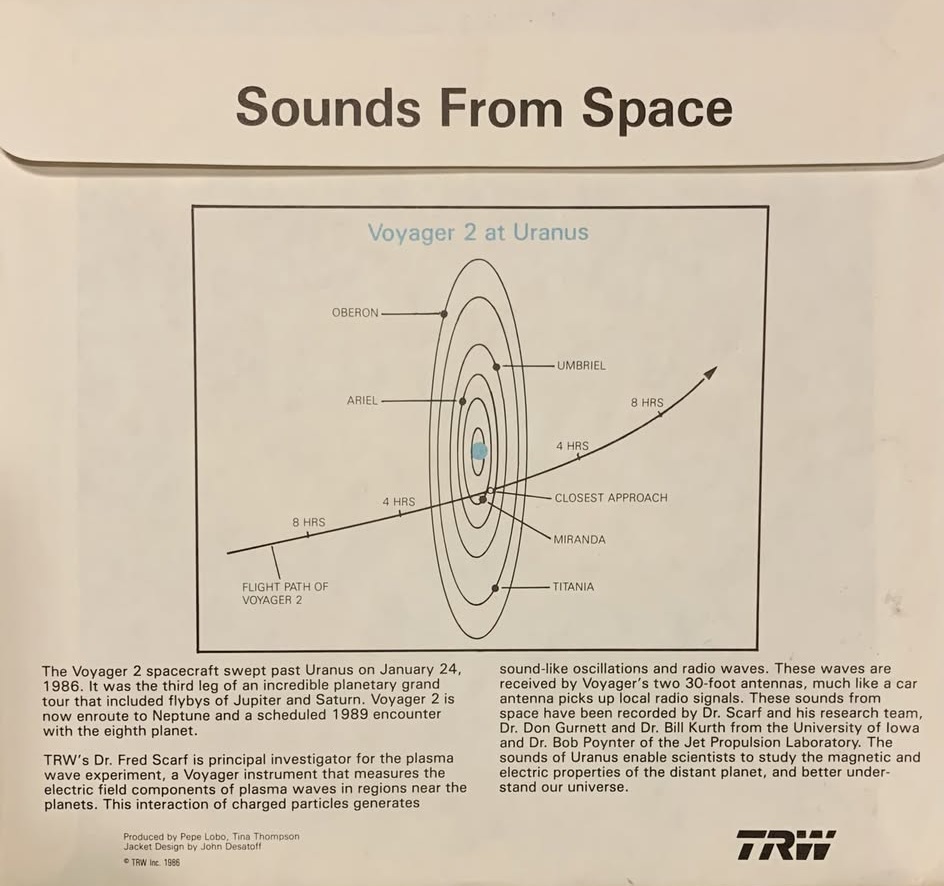
There’s a lot going on here, but let’s start at the beginning: did Voyager I and II really collect sounds from the outer planets and their moons as they passed by? Yes, in a way. Each of the probes was equipped with something called a Plasma Wave Subsystem (PWS), two 30-foot antennas and a frequency receiver that convert the vibrations of dense plasma or ionized gas into audio recordings. The technology was developed by TRW researcher Frederick Scarf, who many of Thompson’s space albums are dedicated to, and continued by Scarf’s successor, Donald Gurnett.
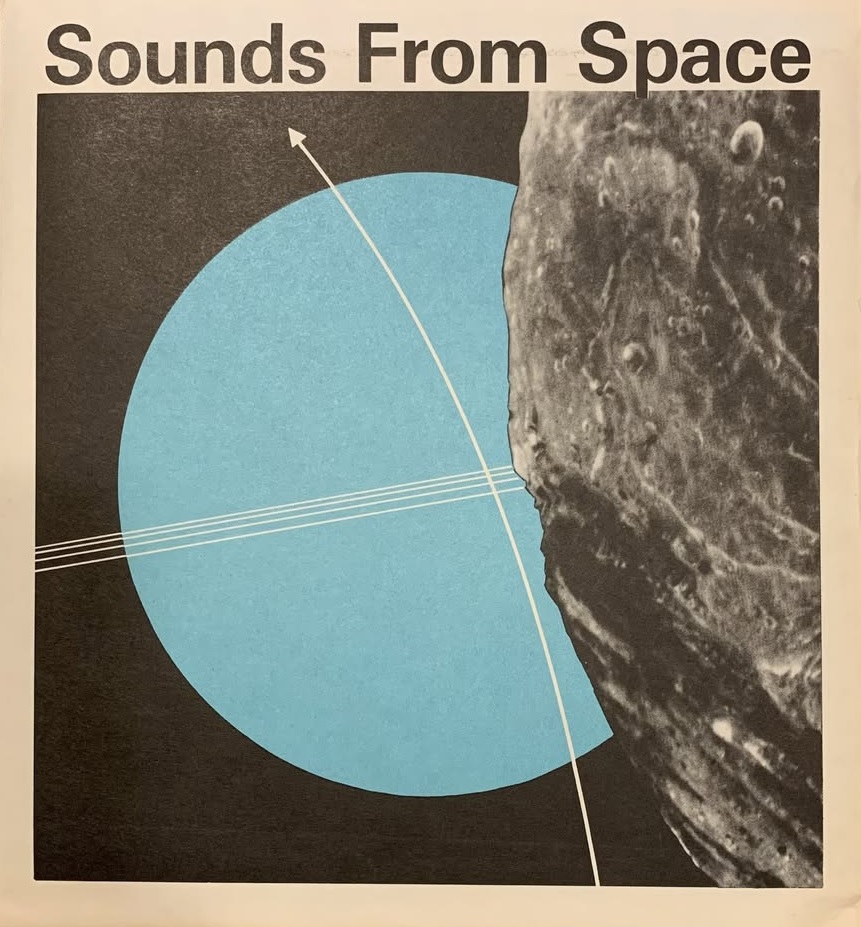
These “sounds of space,” in fact, were released on vinyl by Scarf and TRW at least twice: Sounds of Saturn in 1982 (listen here), and Uranus: Sounds from Space in 1986. On the former, “Additional sounds from the region near Saturn’s rings were reconstructed… using a terrestrial music synthesizer.” Both albums were flexi-disc promotions of the PWS project, very similar to environmentalist Roger Payne’s Songs of the Humpback Whale, a flexi-disc included in a 1979 issue of National Geographic that excerpted his 1970 multi-platinum LP of the same name. Payne’s groundbreaking field recordings galvanized wildlife conservation and helped lead to a ban of commercial whaling in almost every country. They were also a sonic touchstone of the New Age movement. The whale songs, of course, are included on Voyager’s Golden Record, the ultimate “message in a bottle” meant for the eyes and ears of intelligent extraterrestrials.
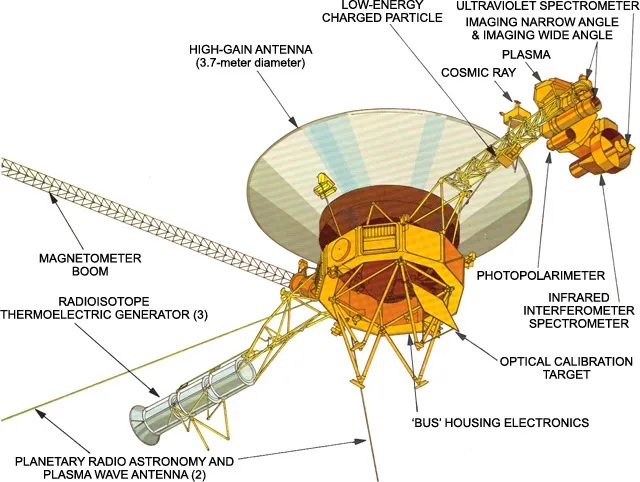
NASA image of Voyager showing the plasma wave antennas
And what about this mysterious cassette from the mysterious RB? Did Thompson really get a copy? If he did, he wasn’t the only one. In June of 1989, composer Michael Lee Thomas and music producer Jeff Littleton toured JPL with Voyager’s Science Sequence Coordinator, Randii Wessen, who gave Thomas “a large package of research material, including a cassette recording of the ‘plasma waves’”—not exactly a top secret affair. Thomas had been planning a traditionally orchestrated “suite” as an homage to the Voyager mission, but after hearing the “eerie… chirping and sounds like a choir,” he decided to write a symphony using those very sounds. The result, 1990’s Voyager: Grand Tour Suite, is a saccharine, somewhat pompous keyboard album that’s entirely too reminiscent of the Doogie Howser intro. There’s nothing eerie or “primordial” about it, unlike the Symphonies of the Planets recordings, which were obviously treated with or wholly created by terrestrial analog synths.
Throughout 1990, before they were collected into five volumes and picked up by Laserlight, individual CDs were released by Brain/Mind Research for each planet and moon: Uranus, rings of Uranus, Miranda, Saturn, Saturn’s rings, Jupiter, Io, and Neptune. In the “Collector’s Edition,” also 1990, we’re told that “The music you hear on this CD was created entirely with space sounds recordings.” But not quite: “Each ‘instrument’ sound you hear is actually the recording of a Voyager sound compressed electronically down to its fundamental harmonic frequency.” The mystery is as deep as space itself: “each ‘instrument’ sound you hear… is truly the ‘harmonic essence’ of that particular celestial body.” What’s a “harmonic essence” and how does one acquire it, you ask? “This process of ‘Harmonic Extraction’ of a recording’s fundamental frequency is an exclusive process developed through the research activities of”—here it comes—”Brain/Mind Research.”
There’s an easy way to know for sure what’s real and what’s… harmonic essence. Because the raw audio data from Voyager isn’t locked away in a vault or the warehouse at the end of Raiders of the Lost Ark, RB’s paranoia notwithstanding. All available sounds extracted by the PWS have been preserved at the University of Iowa Space Physics site by Don Gurnett (who passed away in 2022) and his team. Longer samples can be found at Space Audio, including this over four-hour 1979 Voyager 1 Jupiter encounter. “These sounds,” says the narrator of Sounds of Saturn, “are exactly what one would hear connecting a pair of earphones directly to the [PWS] antennas.” Altogether, they are a fascinating collection of stark static pierced by knocks, shrieks, gurgles, squelches, pings. They’re also a significant scientific accomplishment. But they are not music.
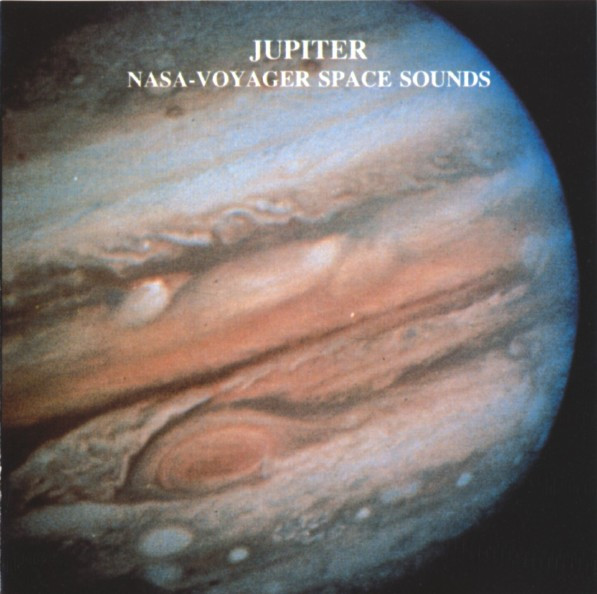
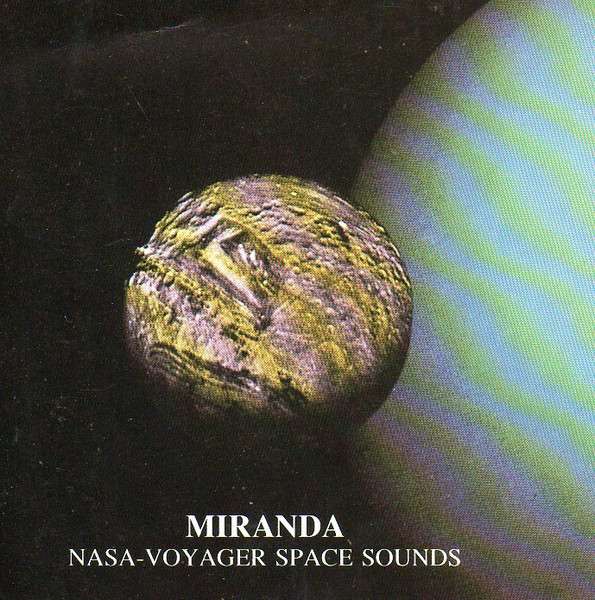
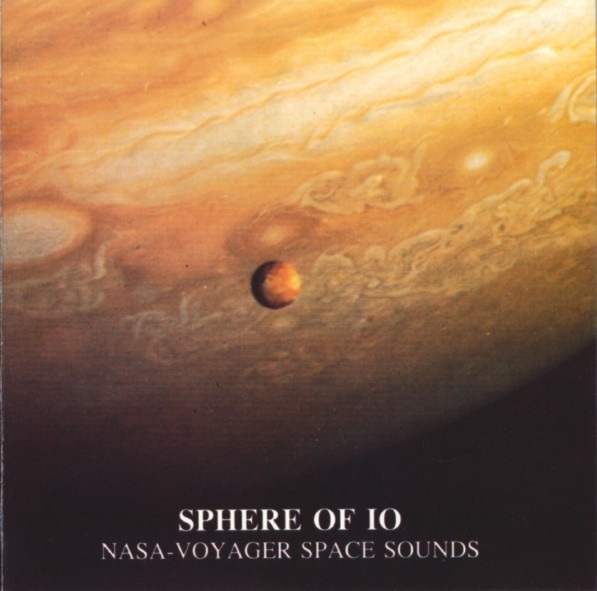
Jeffrey Thompson’s creations, on the other hand, are a brilliant and influential contribution to what we now call space ambient. In his version, or frequency, the static becomes a drone. It’s slower and pitched lower, like the engines of a sci-fi starship—a Star Destroyer, the Nostromo, the Enterprise. There are no melodies, only subtle tone shifts interspersed with what resembles howling winds and ocean tides, the powering up and down of technology that is not ours, beacons chiming in the darkness. Sometimes I can make out what I think is the slow ringing of Tibetan bowls and, sometimes, choir-like whale songs. There are hundreds of channels and thousands of albums on YouTube and elsewhere that attempt to mimic what Thompson did almost 40 years ago. I don’t know if the sounds he made include the PWS recordings, and I don’t know if they stimulate the neocortex or release trauma in the unconscious mind, but I continue to find them both moving and quieting after more than a decade.
Voyager 1 left our solar system in 2012, right around the time I first heard Thompson’s recordings. Voyager 2 did the same in 2018. They’re both still going, almost three billion miles apart, traveling in opposite directions away from the sun. The Plasma Wave Subsystem is still functioning and, as far as I know, still recording. And that’s what’s important: understanding that Voyager is important: its mission, its accomplishments, its promise, its influence. I’ll never experience interstellar space, but I know what it sounds like, thanks to Fred Scarf and crew. Jeffrey Thompson’s space symphonies, his Music of the Spheres, are what I imagine the primordial cosmos feels like.
 K.E. Roberts is Editor-in-Chief of We Are the Mutants and a freelance writer. He lives in Los Angeles and will never own a house.


 We Are the Mutants