Reviews / June 30, 2026
 Integrati… Disintegrati
Franco Leprino
Eleven, 1977
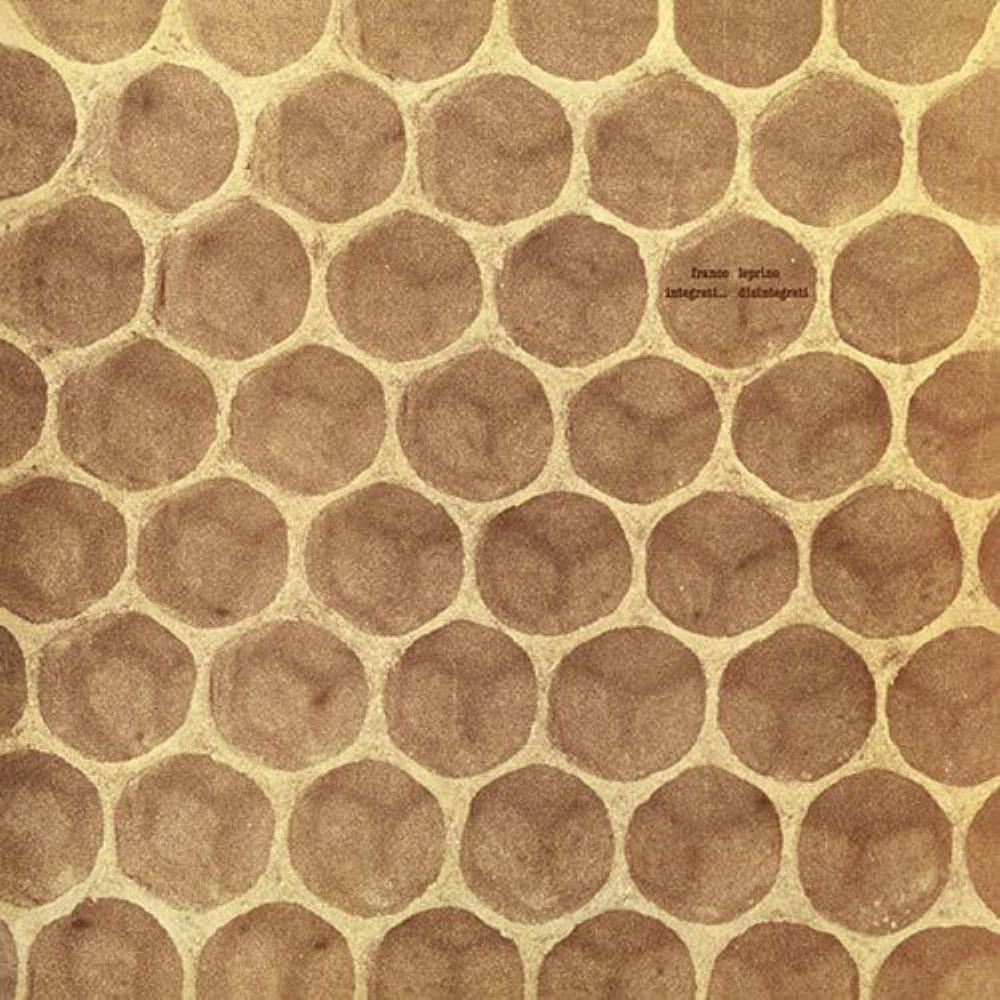
The work of someone called “McPanda,” who seems to have evaporated after the LP’s release, the front cover art of Franco Leprino’s 1977 Integrati… Disintegrati (“Integrated… Disintegrated,” as you’ve doubtless worked out for yourselves) shows the hexagonal cells of what looks like a honeycomb, an artifact that connotes naturalness but also evokes the same queasy blend of the biological and the mechanical that H.R. Giger made his leitmotif. It’s queasy because of the way it calls into question whether the way we live, the things we make, and the stuff we do are actually an expression of our individual personalities and temperaments, or simply the result of our organic machinery acting out its biological imperatives: the only difference between us and the bees being that, by some quirk of evolution, we think we’re the ones running the program, as opposed to being the program’s genetically-triggered executors. It’s one of the big themes that, over its forty-minute running time, Integrati… Disintegrati feels like it touches on.
The work of 24-year-old Sicilian musician Francesco Leprino, Integrati… Disintegrati is a suite of music and sound that constantly oscillates between euphoria and anxiety, blending the “organic” sounds of “real” instruments (in their way as artificial and man-made as any synthesizer) like acoustic guitar and flute, with Moog synths and Binson Echorec tape echoes, as well as a VCS 3 portable analog synthesizer Leprino had bought off Franco Battiato, another Sicilian musician then inhabiting the overlap between progressive rock and the avant-garde. The result is something whose bubbling, tumbling collage of melodies and moods, occasionally shot through with faintly camp, Star Trek-ish sci-fi tones, build into something that sounds both ancient and futuristic, traditional and experimental, optimistic and resigned. And to me at least, though for reasons I’m not sure I can identify, it is somehow a profound and deeply moving meditation on existence.
The album begins with unsettling synth rumbles, over which a recurring guitar arpeggio starts and a slightly tremulous two-note synth warble comes in, providing a motif that will return in various forms throughout the album. After building up to a kind of bubbling frenzy, the sounds then break, like someone waking up from turbulent dreams, to be replaced by reverby waves of arpeggio and washes of synth before cutting to a melodramatic piano refrain and the sound of chewing—human or otherwise—only for that then to mutate into a jolly little jig. And that’s pretty much how Integrati… Disintegrati continues: a baby’s crying gives way to sequenced arpeggiating, to keyboard stabs, to the roaring of a crowd, to echoing arpeggios, unnerving electric humming, squelchy electronics, chewing, crackling sounds, plaintive melodies, phasing, bucolic guitar refrains, disturbing electronic pulsing… You get the idea.
In a 2024 interview in Italian magazine The New Noise, Leprino—a lifelong left-winger and antifascist—says that the febrile political situation at the time in Italy—more specifically in Milan, where he was then attending university—was an influence. 1977 was one of many intense periods in Italy’s Years of Lead, the two decades of social and political unrest that started in the late ‘60s. The law permitting abortion had been passed by the parliament at the beginning of the year but would later be blocked by the senate. Left-wing and neofascist violence was rampant, kneecappings and executions frequent, and in May university student Giorgiana Masi was shot dead during a demonstration, with both sides accusing the other of responsibility. “In those very turbulent times,” says Leprino in the same interview, “I could clearly see on one side the Integrated and on the other those like me, the Disintegrated, the ones who couldn’t and didn’t want to conform.” “In my approach to composition,” he went on, “I wanted to make these contradictions manifest with some passages that were deliberately disturbing. You can hear the crying of a baby and the sound of an enraged crowd. Next to a sweet melody there are cold, desolate sounds.”
So is Integrati… Disintegrati actually about the way we form and then decompose as societies, as consciousnesses, as physical entities? I’ve no idea if that was really Leprino’s intent, but whatever his aims, it’s a stirring, elegiac, and sometimes even harrowing piece that hovers between music and memories of perceptions, billowing out and fading away, occasionally gathering momentum and coalescing into something before fragmenting again like waves on the shore. I’m no expert on the experimental music of the time, to put it mildly, so I can’t really say how the LP fits into the overall landscape of what was happening, though there are certainly things that to my uncultured ears hint at prog, folk, Mike Oldfield, and even the previous year’s Oxygène by Jean-Michel Jarre, though it’s obvious that there are more diverse artists and genres at play. In fact, Leprino cites as influences Stockhausen, Cage, Berio, and Schönberg, as well as the releases of German space rocker label Kosmische Kuriere, music by entities like Manuel Göttsching, Klaus Schulze, Popol Vuh and Ash Ra Tempel.
On paper it might sound like dull conceptualism, but there’s something very alive about the album. Maybe I’m simply projecting my own thoughts onto it, or perhaps it’s something to do with getting older, but Leprino captures something of my feelings about my own life so far. As I look back on it and realize that what felt, to whatever extent, like a direction or an intent was in retrospect more like a cell of a beehive being assembled or a sheet flapping in the winds of existence. And perhaps it’s that very ephemerality that makes life, and Integrati… Disintegrati, so strangely human.


