Selling the Idyll: Christmas Greeting Cards, 1950 – 1980

Christmas cards became ubiquitous in the post-war era, when millions of Americans retreated to a more secluded existence in the rapidly developing suburbs. As small towns—idealized by Frank Capra and Norman Rockwell, among others—started to be displaced by tract housing complexes and chain stores, embellished scenes of the vanishing idyllic communities became a standard trope on greeting cards…
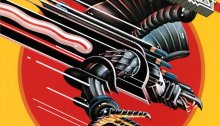
Judas Priest Album Covers by Doug Johnson, 1982 – 1986

Disappointed with his cover art for their 1980 LP Point of Entry, British heavy metal band Judas Priest decided to part ways with the Polish designer and artist Rosław Szaybo. Szaybo, who had previously created artwork for bands as diverse as Soft Machine and The Clash, had supplied the group with a triptych of memorable album covers whose imagery, particularly that of British Steel, had helped consolidate Priest’s image…

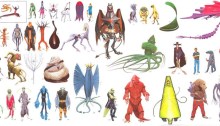
Alien Grimoire: ‘Barlowe’s Guide to Extraterrestrials’, 1979

The work of what its creator called “a hungry youth with something to prove,” Wayne Barlowe’s 1979 Barlowe’s Guide To Extraterrestrials was published amidst a glut of grimoires of imaginary realities—Wil Huygen’s Gnomes had been released in 1976 and Stewart Cowley’s Spacecraft 2000-2100 AD in 1978, while 1979 saw the release of Cowley’s Aliens in Space: An Illustrated Guide to the Inhabited Galaxy (written under the pseudonym of Steven Caldwell), as well as David Day’s Tolkien Bestiary and Alan Frank’s Galactic Aliens

A Final Outrage: The Album Art of Blue Öyster Cult

By Richard McKenna

Despite the dispiriting fug of “classic rock” that hangs about their name—largely thanks to the persistence in popular culture of the song for which they are best known, the wonderful but largely unrepresentative “Don’t Fear the Reaper—Blue Öyster Cult began life as a high-concept countercultural proposition whose aim was to bring an underground literary and musical sensibility, as well as wit, to the dull, self-indulgent ceremonies of rock…

SNIKT: Comic Book Sound Effects, 1939 – 1985

Sequential art goes all the way back to cave paintings, and word balloons start to appear in political cartoons in the late 1700s, but the combination of the two in newspaper comic strips was a late 19th century development, spurred by the “circulation war” between Joseph Pulitzer’s New York World and William Randolph Hearst’s New York Journal

‘Long Distance Kiss’ by Syd Brak, 1982

As the grimmer social realities of the 1980s began to take hold, more abstract aspirations began to fuel the collective imagination, and the airbrush—a device originally invented in the second half of the 19th century—proved to be an effective tool for creating dreamlike imagery that combined the smooth realism of the photograph with the artifice of the painting while eliminating the potential dissonances of both…

Selections from ‘Suburbia’ by Bill Owens, 1973

Look at that living room, so similar to many of the ones I grew up around and yet so much less pokey, so much more relaxed. Those cars, those bizarre technologies we were constantly struggling to understand in cartoons and comics—pull carts, barbecues, six packs—all in the middle of this massive, consequenceless nowhere where it was always warm and never rained. We lived in estates too, but nothing like these huge, smoothly landscaped labyrinths, low to the ground like military installations. Wow, what a place…