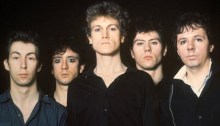
“Don’t Get All Historical!”: The Seaside Gothic of The Beatles’ ‘Magical Mystery Tour’

By J.E. Anckorn and Amy Mugglestone

At 8:35 pm on Boxing Day of 1967, the people of Britain gathered around their television sets to witness the Beatles’ new film project, Magical Mystery Tour. Their first filmed project since the daffy caper Help! (1965) accidentally created the sound of the late ’60s, the project was meant to act as a replacement for the live shows they were no longer performing…
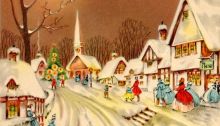
Selling the Idyll: Christmas Greeting Cards, 1950 – 1980

Christmas cards became ubiquitous in the post-war era, when millions of Americans retreated to a more secluded existence in the rapidly developing suburbs. As small towns—idealized by Frank Capra and Norman Rockwell, among others—started to be displaced by tract housing complexes and chain stores, embellished scenes of the vanishing idyllic communities became a standard trope on greeting cards…

‘Top of the Pops’ Christmas Special, 1979

For the pop-minded inhabitant of the British Isles in the late ’70s, the dull edifice of the passing weeks rested upon the two mighty, glowing columns that made it all bearable: the British Top 40 countdown, broadcast from 5:00 on BBC Radio 1 every Sunday evening (cancelled only once as a result of what would prove to be an inexplicably traumatic event for the nation: the 1997 death of Lady Diana) and Top of the Pops

René Alleau’s ‘History of Occult Sciences,’ 1966

The vogue for illustrated mini-encyclopedias of world knowledge came into its own in the postwar period in the West. The spirit of New Frontier, space-age optimism led traditionally non-educational publishers into the educational field, usually by producing striking, lavishly-illustrated, glossy full-color gazetteers on particular areas of knowledge…

The Music the Machines Make: ‘Systems of Romance’ by Ultravox

By K.E. Roberts

London’s Ultravox was John Foxx’s band for three increasingly brilliant albums. Their debut, 1977’s Ultravox!, is an uneven but essential distillation of Roxy Music, art-rock-era Brian Eno (who produced, along with Steve Lillywhite), prog, minimalist electronica, and dub. The same year’s Ha!-Ha!-Ha!, on the other hand—a mere eight months separated the albums—is a focused and unsparing gnashing of teeth…