“21st Century Global Guardians”: Corgi’s X-Ploratrons, 1979

Billed as “global guardians,” the X-Ploratrons were four toy vehicles, each equipped with its own novelty tool—mirror, magnifying glass, compass, and magnet—and charged with protecting humanity in the “fictitious disaster-wrecked world of the 21st century,” where “the elements rebel against man!” They were long-established die-cast toy brand Corgi’s attempt to adapt to the wave of SF-driven commerce that followed the unprecedented success of Star Wars

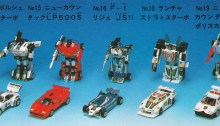
Diaclone Television Commercials, 1980 – 1984

Having become an aficionado of YouTube compilations of television commercials from the ’70s and ’80s, being introduced to this particular collection was a real treat. And such an uncanny one! Here are the Transformers I played with as a kid—Optimus Prime, Wheeljack, Ratchet, Sideswipe—in their original context as members of the Diaclone (ダイアクロン Daiakuron) line of toys from Japan…

Sorry No Gas: Photos from Documerica, 1972 – 1975

At the dawning of the 1970s, Americans were more aware than ever of the great damage more than a century of unrestricted industry had done to their country. With the passing of Richard Nixon’s Reorganization Plan Number 3 by Congress in 1970, the U.S. government welcomed the Environmental Protection Agency to the roster of federal agencies. The EPA was meant to consolidate federal efforts to protect America’s air, water, and soil, and to give environmental protection efforts a fiercer executive independence…

Paul Bacon Cover Gallery, 1952 – 1983

After serving in the Marines during World War II, self-taught artist and typographer Paul Bacon (1923-2015) landed in New York City, where he designed several now-famous album covers for jazz labels Blue Note and Riverside Records. Bacon had discovered jazz in the ’30s, and he remained a great fan—he was befriended by Thelonious Monk, among others—throughout his life…

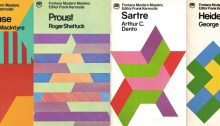
Fontana Modern Masters Cover Gallery, 1970 – 1984

The Fontana Modern Masters series was conceived in the late 1960s at Scottish publishers William Collins & Company’s Fontana imprint. Fontana Books had spent its first decade publishing inexpensive paperback pulp and detective fiction, priced between two and three shillings. But, in May 1968, revolutionary theory and Situationist praxis caught fire in the streets of Paris, as students plastered walls and barricades with catchy slogans meant to détourne the mainstream postwar advertising culture around which they’d grown up…

‘Science Fiction Monthly’ Cover Gallery, 1974 – 1976

From a merger of its 1961 acquisitions—British publishers Ace Books Ltd. and Four Square Books Ltd—the American Times Mirror Company created the New English Library (NEL) as a sister company to the New American Library. While the latter retained some of the cultural prestige of its original owner, Penguin Books, the NEL was under no such constraints of perceived quality: the publisher was therefore free to specialize in paperback genre fiction…

Portraits of the Mushroom Cloud, 1946 – 1990

From the moment atomic weapons were first inflicted on the planet in 1945, the mushroom cloud became one of the defining motifs of the second half of the 20th century, assuming an almost supernatural significance that would only increase over time. It might seem paradoxical to speak about serendipity in the case of something that has been the cause of so much misery, but it’s hard to imagine nuclear weapons occupying quite the same space in the human race’s imagination had their effects not taken such a recognizable shape…

Designs for Radicalness: ‘Thrasher’ Magazine, March, 1986

The sport and art of skateboarding advanced rapidly in the 1980s, as did the subculture surrounding it. Though limited mostly to the contest circuit and empty pools and reservoirs (a Southern California discovery brought about by drought) in the previous decade, the invention of the polyurethane wheel and other advancements—wider, lighter, concaved decks with a pronounced kicktail—allowed skateboarders to go faster and develop new tricks…