By Richard McKenna / June 1, 2026
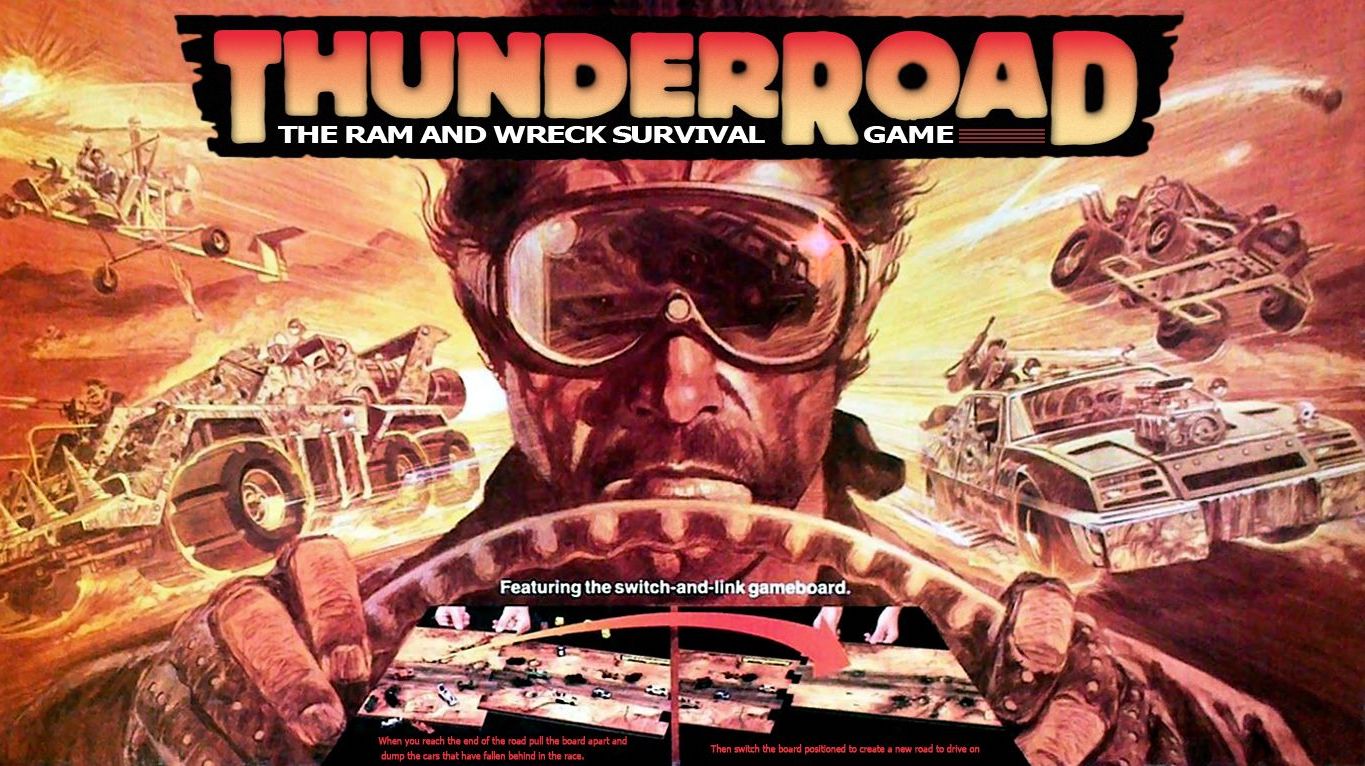
Object Name: Thunder Road: The Ram and Wreck Survival Game
Maker and Year: Milton Bradley, 1986
Object Type: Board Game
Image Source: Board Game Geek
Description: (Richard McKenna)
Hey, coddled yet anxious western child of 1986! Want to play an exciting new board game based on the premise—pilfered from a violent adult exploitation flick—that societal collapse is around the corner, fuel is about to become the only currency, and your future life will consist of little more than attempting to stay alive by running your enemies off the dirt tracks that pass for roads in your tricked-out muscle car? If so, hobble rapidly down to your nearest toy outlet and purchase Milton Bradley’s Thunder Road!
Incredibly, it took only four years for the spectacle to regurgitate the absurdist nightmare future that George Miller had assembled in 1982’s Mad Max 2 (or one year from the limp PG-13 version, 1985’s Mad Max Beyond Thunderdome) as that most inane and transitory of commodities: a children’s board game. The world of 1986 had moved on from the novelties that had originally forged toy company Milton Bradley’s reputation—here a player’s goal was no longer the bougie boomer dream of retiring with a stack of money in the bank like in The Game of Life; it was to try and outlive your fellow drivers while you kept on trucking down that endless post-apocalyptic highway to nowhere.
Throughout the ‘80s, flavors of millenarian Armageddon tended to be either straightforward nuclear annihilation, a return to a (nominally) peaceful agrarian past, or an acceleration into the kind of nitro-fueled futures displayed here. The shoots that had grown into “Mad” Max Rockatansky’s gasoline-burning muscle-head hellscape had their roots in socially pessimistic sci-fi like 1969’s Damnation Alley and Ib Melchior’s “The Racer” (the 1952 short story that Roger Corman optioned as the basis for his 1975 Death Race 2000 when he saw an opportunity to capitalize on the controversial sports’n’violence spectacle of Rollerball) and the oil crises of the 1970s. Here were two veins of social anxiety that, when filtered through a car culture so deeply ingrained that we’d started thinking cars might actually be alive, flowed together into the trope that was Thunder Road’s setting. To paraphrase some smart aleck, it was easier for the Westerners of the ‘80s to imagine the end of the world than the end of cars.
The debut of games designer Jim Keifer, Thunder Road was only the latest in the line of demolition-derby diversions more usually aimed at older teens or adults that had gained traction (heh) with the release of the the aforementioned Paul Bartel-directed Death Race 2000, and which included 1976 arcade game Death Race, Steve Jackson’s 1980 Car Wars, 1981’s Highway 2000, 1982’s Maze Death Race for the ZX81, Games Workshop‘s 1983 Battlecars—which spawned a ZX Spectrum video game of the same name the following year—1985’s Freeway Fighter, a roleplaying gamebook that was part of Steve Jackson and Ian Livingstone‘s Fighting Fantasy series, and Roadwar 2000, which came out the same year as Thunder Road.
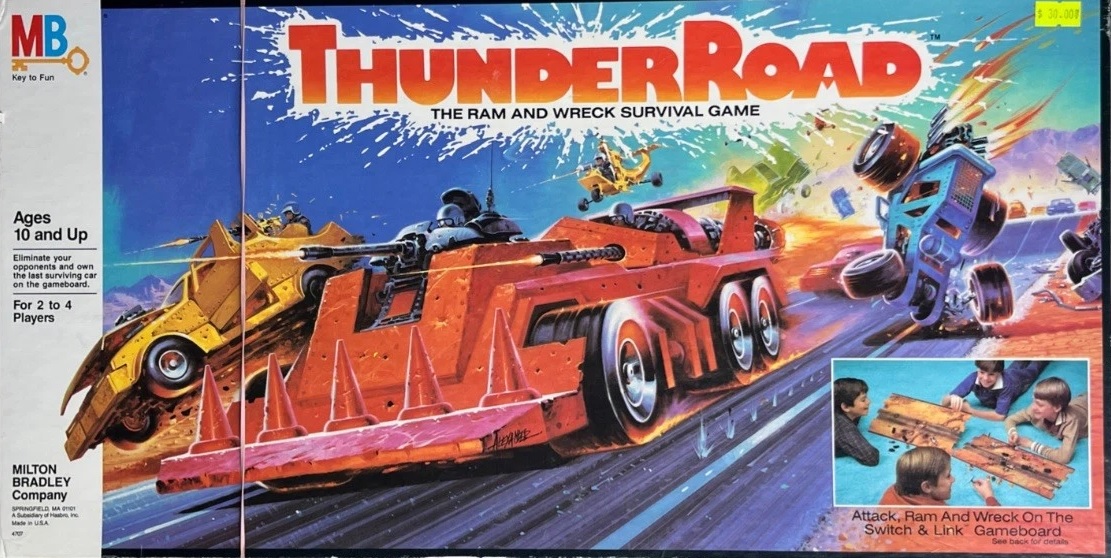
More than any of them, Thunder Road epitomizes those games and toys pumped out in the ‘70s and ‘80s where playability comes a distant second to manifesting the symbolic spirit of the age in cost-effective plastic and cardboard form, and it followed its kid-conning precepts closely: an enormous yet practically empty box featuring incredible cover art that, at least on the first, more kid-friendly version seen below, was illustrated by Paul Alexander.
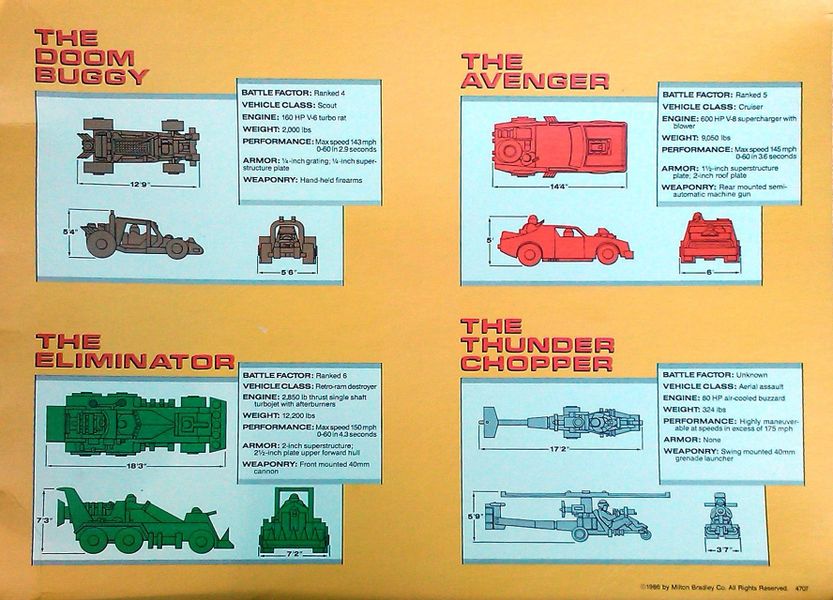
The contents included miniscule plastic versions of the vehicles from the game’s progenitor—Max’s V8 Interceptor, the Gyrocaptain’s chopper, and some kind of roided-up version of Auntie Entity’s jet car—as well as Thunder Road‘s patented “switch-and-link gameboard,” a two-piece slice of blasted earth and cratered asphalt that allowed the play to continue infinitely, or at least until all present were bored to death by what, to judge by appearances, looks like a cataclysmic dearth of entertainment. It’s impossible to say whether the inspiration for the game’s name came from the Springsteen song or the Robert Mitchum-starring hicksploitation movie, but Thunder Road‘s TV commercials definitely leaned into the hard rock, albeit of an even hoarier type than that peddled by The Boss.
It’s odd to imagine that something as grim as the breakdown of society—which to many at the time seemed an actual possibility—and subsequent reversion to barbaric might-makes-right could have been seen as appropriate material for children’s toys, though it evidently was, even when packaged for a target audience younger than that of Thunder Road. But then again, given the number of Gen X boys whose sacred texts were stuff like Frank Miller’s The Dark Knight Returns (also 1986), Mack Bolan, John Carpenter movies, and 2000 A.D., Thunder Road ends up feeling as much of a cardboard and plastic inevitability as the end of the world itself.


Turns out to have been a fairly entertaining game after all, enough to have spawned a recent reboot as _Thunder Road: Vendetta_
I’m sure it actually is fun – just not a board games person myself, unfortunately!