By Michael Grasso / June 3, 2026
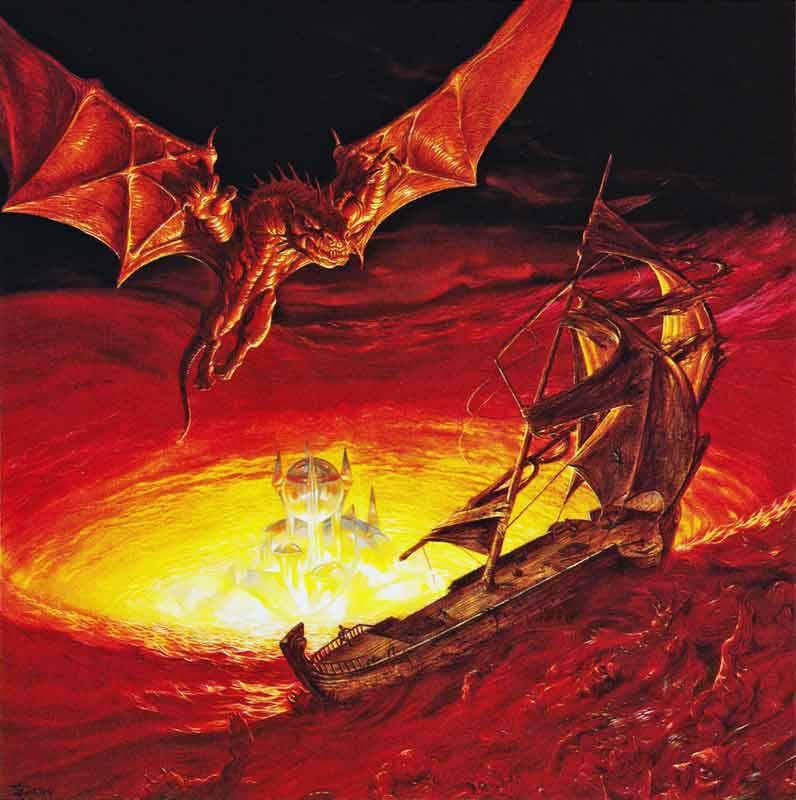
“Sailing the Blood Sea of Istar,” Jeff Easley, 1986
A couple of years ago, a canny and intelligent friend referred to the Advanced Dungeons & Dragons setting of the Forgotten Realms as “post-apocalyptic.” I thought for a moment, ready to dismiss the fictional world’s bog-standard fantasy feudalism as nothing of the sort, when one of those huge realizations hit me square between the eyes: wait a second, all three of the original AD&D campaign settings are technically post-apocalyptic! It’s not something I had consciously realized before that moment, even though I was reasonably (okay, maybe obsessively) well-read in the histories of these worlds: the Forgotten Realms‘ Toril, the World of Greyhawk‘s Oerth, and Dragonlance‘s Krynn. And it’s not like the idea of an expressly post-apocalyptic setting was alien to me: I’d played loads of role-playing games set on a destroyed Earth (more or less) and AD&D itself, as it moved into its Second Edition in the late ’80s and early ’90s and introduced Dark Sun, a brutal, dystopian world ravaged by magically-induced climate change and ecological destruction, where dragon-sorcerer-led empires tyrannically rule their subjects.
The World of Greyhawk, Forgotten Realms, and Dragonlance all adhere more or less to the standard medieval fantasy setting codified by Tolkien and his many heirs and imitators: there are “good” kingdoms, where the standard AD&D player character races (dwarves, elves, halflings, humans, etc.) dwell, and “evil” kingdoms, which are led by worshippers of dark powers (more often than not members of the “evil” races of the world). There’s an acknowledgement of a vague geopolitics at the highest levels of each world underpinning the internal politics, economics, and culture of the various kingdoms, and in the past of each world there is a singular cataclysmic event that reshaped the planet’s geography and history and set the campaign setting into the form with which all these AD&D players and dungeon masters engage. I found myself curious: why? What are the roots of this trope, both in AD&D‘s predecessor media and in the real world? Is the concept of an ancient global disaster somehow central to these campaign settings as worlds for adventurers to explore (and pillage)?
Greyhawk first appeared in print as the title of a 1975 Dungeons & Dragons supplement, after adventurers at D&D co-creator E. Gary Gygax’s gaming table had delved deep into his “Castle Greyhawk” dungeon. Gygax continued to develop the setting, basing published adventure modules in it, even after the release of 1980’s The World of Greyhawk (commonly referred to now as the “Greyhawk Folio”), which included the glorious fold-out map by early D&D artist Darlene, and CIA Factbook-style descriptions of dozens of nation states on Oerth’s continent of Oerik and the region known as the Flanaess. In sculpting the history of the Flanaess, Gygax used as backdrop a monumental magical war about a millennium in the region’s past between two great empires, the Baklunish and the Suloise. Both empires were mono-ethnic and stretched across the Western Flanaess. Elsewhere in the Folio, Gygax describes Baklunish successor states as “paynims” ruled by “sultans,” “shahs,” and “khans,” an amalgamation of various real-world West Asian ancient and medieval cultures. Meanwhile, the Suloise (according to the expanded World of Greyhawk box set from 1983) are “fair-skinned, some being almost albino.” The description of this magical conflict in the Folio sounds tantalizingly similar to a nuclear exchange:
This bleak desert is the Sea Of Dust, the former Empire of Suel or Suloise. History tells us that this was once a fair and fertile realm extending a thousand miles west and southwards, too. The merciless and haughty rulers engaged in a struggle for dominance and supremacy over all of Oerik with the Baklunish, and in return for a terrible magical attack, the Sulolse lands were inundated by a nearly invisible fiery rain which killed all creatures it struck, burned all living things, ignited the landscape with colorless flame, and burned the very hills themselves into ash.
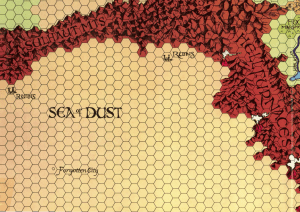
The former Suloise Empire, now the Sea of Dust, tucked away into the southwest corner of Darlene’s map of the Flanaess.
This pair of catastrophes, the Invoked Devastation and the Rain of Colorless Fire, render much of both homelands into a desert, with the Suloise suffering the worst of it. (A complete history of references to the dual devastations in Oerth’s history, from the Greyhawk Folio up to Gygax’s final word on the matter in the 21st century, can be found here.) Gygax, whose famous “Appendix N” in the AD&D Dungeon Master’s Guide included classic works of fantasy and science fiction that inspired his development of D&D, encouraged his players in early modules and rulebooks to explore crossovers with other genres including, conveniently, TSR’s Boot Hill (an Old West setting, 1975) and Metamorphosis Alpha (sci-fi, 1976). This passage from the Folio reminds me most of post-nuclear apocalypse fiction, such as Walter Miller’s 1959 A Canticle for Leibowitz, where the re-primitivized survivors of nuclear war struggle, centuries after the conflict, to understand the paradoxical killing effects of radiation: invisible yet burning and deadly.
For Gygax, the primary impact and narrative purpose of the Invoked Devastation and the Rain of Colorless Fire on the Flanaess is ethnic migration. Before the final exchange of magical holocausts, the populations of both ancient empires had already begun to flee the conflict. But the dual devastations set the stage for a new status quo in the Flanaess: a tribal, post-imperial era of reorganization where ethnic groups (which also included the Oeridians, who possess “skin tones ranging from tan to olive,” and the Flan, an indigenous “bronze-colored” group for whom the Flanaess were named) first self-sorted into enclaves that, eventually, resulted in more heterogeneous populations. In Gygax’s words, “humankind, as is its wont, has industriously intermixed.” The Suloise, in the aftermath of the Rain of Colorless Fire, have scattered to the literal four winds, escaping as far north as Oerth’s arctic to found the Nordic-coded nations of the “Frost, Ice, and Snow Barbarians” and to the tropical southeast, where some Suloise retreat into the dark jungles of the Africa-like Hepmonaland, while others found a secret society-ruled land of evil Suloise-supremacist thieves, assassins, and monks called the Scarlet Brotherhood, who try to infiltrate and corrupt competing nations from within.
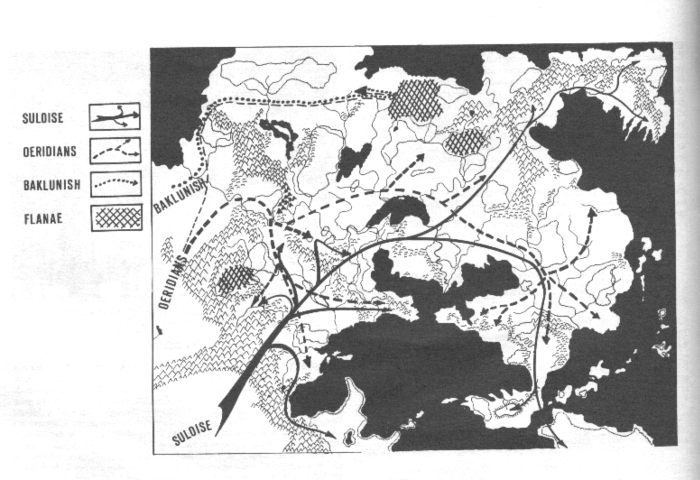
Map of ethnic migrations across the Flanaess from the 1980 Greyhawk Folio.
Conveniently, the Suloise become a (not literal) bugbear for the Greyhawk campaign world, an ancient, degenerate race that can be plugged into any number of fantasy tropes. The cosmopolitan intermixing that created the “good” nations of the Flanaess finds its enemies in nations that extol “purity” of various kinds, whether the mad, inbred Oeridian nobility of the Rome-coded Great Kingdom or the religiously intolerant Theocracy of the Pale. Despite Gygax’s well-attested tendencies towards race and gender essentialism, evident in many spots in both the Greyhawk setting and the D&D rules as a whole, he does seem to see the value in racially and culturally pluralistic societies, while acknowledging some nations still adhere to doctrines of native racial superiority. From the 1983 World of Greyhawk box set:
In general, the skin color of an individual is of no particular importance… In the central region of the Flanaess… there is little heed paid to either skin color or racial type, whether human or demi-human (or even humanoid, in some places)… In contrast, the nobles of the Great Kingdom are proud of being light-skinned, just as the rulers of Tenh are overly conscious of the supposed superiority of their deep bronze color.
Gygax was a longtime student of the history of warfare, and D&D grew out of historical wargaming. Clearly, whatever moral judgments he might levy on his fictional nations, Gygax’s big-picture engine of history, both real and fantastical, hangs almost solely on the dynamics of racial and national conflict, and his ancient devastations in Greyhawk serve as both a result of these conflicts and a generator of the in-group migration that creates the kind of over-narrative that makes a Gygaxian campaign world go ’round.
The Forgotten Realms, like Greyhawk, began in the mind of one man: Ed Greenwood. “The Realms” were the setting for Greenwood’s childhood sword and sorcery stories, which he turned into a campaign world when he discovered Dungeons & Dragons in the 1970s. Like Gygax, Greenwood slowly built his setting in TSR publications: in this case, the pages of TSR’s Dragon magazine in 1979. TSR released a Forgotten Realms box set in 1987, formatted very much like Greyhawk’s 1983 set: two guidebooks full of setting information and big folded maps of Faerûn, the continent on which the action takes place. Like the Flanaess, Faerûn includes states at a medieval level of technology, with magic both divine and arcane fairly common. The overall cultural milieu is Western European medieval, with some fringe states, as on Oerth, reflecting cultures that closely border on Europe’s (the Realms have their own cod-Middle Eastern, East Asian, and Central American regions). And like Oerth, Greenwood’s ancient history of Toril contains a magical disaster, a war of sorts that, like Greyhawk’s Rain of Colorless Fire, created a huge wasteland.
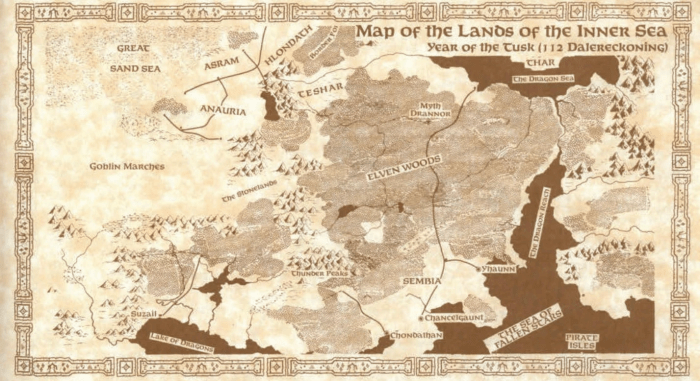
A map of central Faerûn in the centuries following the fall of Netheril. The “Great Sand Sea” of Anauroch would eventually subsume extinct states such as Asram, Hlondath, and Anauria (which would give the desert its name).
Roughly two millennia before the “present-day,” there stood an ancient empire called Netheril, ruled by an elite caste of magic-users. Netheril gets passing mention in the 1987 set, but Greenwood expanded on the background a few years later, penning a supplement in 1991 titled Anauroch. The supplement explores the origins of the vast desert of the same name, descending through the center of Faerûn, cutting the eastern kingdoms of the Moonsea and Dales from the “frontier” lands of the West, called the Sword Coast. Anauroch’s origins as a slowly-growing desert wasteland are tied deeply to old Netheril. The magicians of old Netheril had a purer access to magic, but it came at a cost. A race of underground creatures called the Phaerimm, “foul and dangerous to human eyes,” found their existence threatened by Netheril expansion and magical experimentation:
Phaerimm magics were interfered with, or destroyed. Magic (in the hands of the human wizards of Netheril) was used to slay encountered Phaerimm monsters as the humans began to explore, mine, and alter the underways, seeking gems and metal-ores.
They found death. The most powerful Phaerimm worked together to develop a mighty spell that would destroy the things that humans lived on: the lifedrain.
The lifedrain triggers, causing a collapse of Netheril’s magic-run society, inconveniencing the “decadent, self-interested” mage lords but killing their servant class: “[T]he folk of Netheril who could not work magic were slaughtered and terrorized by the score in the magical fray.” Greenwood’s investigation of class in this cataclysm and the subsequent migrations is fascinating, considering Gygax’s considerably less nuanced history absent of those dynamics. “The Netherese had lost the need to stand and fight together, and were given no time to regain it,” Greenwood says. “The common folk, with no leadership or salvation from the wizards in sight… fled with what they could carry,” while the ruling class wizards, oblivious nearly to the end, were “deserted by those who fed them and provided for their needs… intent on their own researches and aims over everything else.”
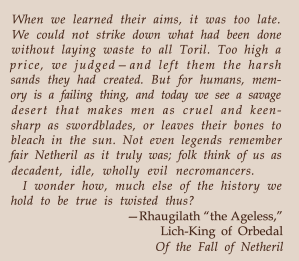
Quote from a lich (an undead wizard) from ancient Netheril in the Anauroch supplement. One aspect of a post-apocalypse in an AD&D campaign world: you can meet the undead inhabitants of the ancient civilization!
Unlike Greyhawk’s Suloise devastation and the Sea of Dust, which is physically trapped behind the Hellfurnace Mountains, Anauroch advances, year by year, slowly swallowing up other lands and empires since the grand catastrophe of Netheril. So this ancient disaster has a clear, direct, ongoing impact on the contemporary campaign world. So the geography of the great desert of Anauroch has more of an effect on the setting’s politics, economics, and cultures than the Sea of Dust does on the Flanaess. Greenwood, in the original Realms box, writes that the desert helped materially create the powerful feudal kingdoms of the central, “civilized” Moonsea and Dalelands: “[T]he encroaching desert has forced trade south through the bottleneck the wastes create, into the realms of Cormyr, Sembia, and the Dales, making these regions the wealthier…”
Netheril acts as a signifier for a lost age. Like many antediluvian settings of the fantastic, from Plato’s Atlantis (which itself served as a potent symbol for many political, philosophical, and esoteric movements throughout our history) onwards, Netheril symbolizes a golden age of advanced magical technology, research, and societal achievement that has been lost in the Realms’ fallen modern era. Netheril/Anauroch is also interesting for its simultaneous adherence to and commentary on the standard logics of a Dungeons & Dragons campaign world: the desert and its Netherese ruins stand as a ready-made setting for dungeon-delving. “What happened to so suddenly and thoroughly sweep all this away?” asks the supplement’s introduction. “DMs will find the answer in The Secret of Anauroch chapter; players perusing these pages should resist the beckoning temptation to peek at it, so as to fully enjoy the perils that lurk in Anauroch.”
Clearly, Anauroch is meant as a source of mystery and discovery for the countless adventuring parties playing AD&D. No less an authority than Elminster, the Gandalf of the Realms (who often acts as an authorial voice for Greenwood) says Anauroch is “the largest—and probably wealthiest-treasure-house in all Toril.” And yet this catastrophe itself orignates from… the Netherese treating the Phaerimm as dungeon-dwelling monsters, fit only for extermination so that they may exploit the riches of the underworld! Netherese expansion and industry attempting to exterminate the monstrous and fearful Phaerimm is merely Dungeons & Dragons‘ main ludic trope writ large, on a societal scale. Adventurers in the Realms who wish to explore Netherese ruins do so on the bones of an earlier millennia-old civilization, itself destroyed in revenge by its own dungeon-dwelling monsters.
With the Dragonlance setting, created by Tracy and Laura Hickman, we approach one of the Advanced Dungeons & Dragons First Edition era’s signal contributions to the role-playing world. The planet of Krynn and the continent of Ansalon, where most of the setting’s original action takes place, was solicited, engineered, designed, and written during arguably the system’s peak years in the early-to-mid 1980s. It was also expressly designed to be different from the standard setting of Dungeons & Dragons: making dragons foes (and, eventually allies) was prioritized, and the setting removed orcs, a standard (and obviously Tolkien-derived) enemy.
Among the many radical changes in the plotline of the Dragonlance adventure modules was the idea that Krynn would, at the outset of the campaign, lack clerics. For those who have somehow avoided D&D tropes over the past half-century, clerics—worshippers of the campaign setting’s various deities and demigods—possess powerful, divinely-bestowed magic and are the only casters who can heal and, at higher levels, resurrect player characters. To begin a campaign with no cleric and, indeed, no gods or divine intervention, was a true subversion of what AD&D had become since its inception. And the Hickmans had a backstory for Krynn that embraced, arguably more completely and thoughtfully than Oerth or Toril, the idea of their campaign world as a specifically post-apocalyptic setting. In the very first introductory “boxed text” (text meant in D&D modules to be read aloud to the players), Tracy Hickman drops a sudden and portentous piece of world-building:
It is a wonder that any beautiful places are left in the world. Before the Cataclysm, the days were calm and ordered; nothing was unexpected. Now the world is changed: its change has taught two great lessons.
First, no beauty—not even that in this valley—is safe. All the riches of the past could not protect the ancient peoples. Gold has no value in the world now: it is too soft for swords or armor. Steel is the most valued metal of all, though each small kingdom has its own currency and exchange.
Secondly, no magic lasts forever: true clerics cannot be found, nor have clerics with miraculous powers been known to exist since the time of the Cataclysm nearly 300 years ago.
This module DL1, Dragons of Despair (1984), and the Dragonlance Chronicles novels that would follow from Tracy Hickman and his co-author Margaret Weis, would focus on the return of the gods to Krynn. A party member, a “barbarian princess” named Goldmoon, finds a set of ancient texts set onto platinum disks—the Disks of Mishakal. Mishakal, the pre-Cataclysm goddess of healing, vouchsafed a healing staff to Goldmoon’s partner Riverwind in his explorations of a pre-Cataclysm ruin. Over the course of DL1, this adventuring party, the eventual “Heroes of the [Dragon]Lance,” will return to this ruin and discover the disks, which make Goldmoon into a true cleric. Of course, the enemies of good—worshipers of the dark five-headed dragon-goddess Takhisis—have already received many gifts of clerical magic and even darker enchantments. What caused the Cataclysm and the retreat of all the gods, good, neutral, and evil, from Krynn? The hubris of one man and the society surrounding him: the Kingpriest of Istar.
Module DL5, Dragons of Mystery (also 1984), differs from the other Dragonlance modules in that it was a guide to Krynn and Ansalon with no playable adventure. But before the release of the official Dragonlance setting book, Dragonlance Adventures, in 1987, DL5 was the only source for Krynnish history. After telling the tales of the creation of the world’s races and the banishment of evil that led to the long peace of the Age of Might, the final zenith of the great theocratic empire of Istar is revealed:
The glory of Istar had now triumphed. An unlimited future of peace was at hand. The forces of evil seemed to have been completely vanished: dragons were no more, and the ogres had been broken. And in the 959th year of the Age of Might, the High Kingpriest of Istar decided to rid the land of even the vestiges of evil by summoning one of the Gods to do his bidding…
The Cataclysm was the result.
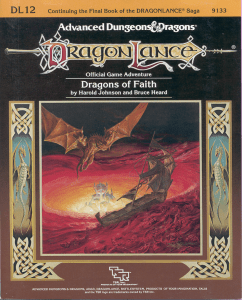
Cover of DL12, Dragons of Faith, where the player characters descend to the ruined city of Istar.
Later novels, such as the Legends trilogy released in 1986, would send some of the Heroes of the Lance back in time to Istar to witness the fall of the great holy empire firsthand, but a capsule description from Dragonlance Adventures of the immediate post-Cataclysm period is some of the most purely and materially post-apocalyptic prose in all three of the campaign worlds we’ve looked at: “The survivors of the Cataclysm struggle desperately to stay alive. Famine spreads across the world and plague follows… Many villages and towns, initially untouched by the Cataclysm, soon vanish because of disease or war.” The material and social impact of “a fiery mountain… flung from the heavens to destroy the city of Istar” is clear: lost wealth, destroyed political authority and social cohesion, geographic upheaval (the creation of a “Blood Sea of Istar” where the city-state and its nation once stood), and widespread misery and death. But for the setting of Dragonlance, more prominently explored is what the Cataclysm did to the people of Ansalon spiritually.
In those early adventure modules, Solace, the hometown of the Heroes of the Lance, is run by theocratic false clerics called Seekers, who have been infiltrated and suborned by mysterious monks who end up being revealed as the evil dragons’ pawns, Draconians: crude, bestial reptilian monsters created by infusing good dragon eggs with devils from the Abyss: Krynn’s own version of Tolkien’s orcs. In DL5, the social and religious history of post-Cataclysm Ansalon is fleshed out further:
Thus did the Gods punish the behavior of their children, and so did they hope that their children would return to the paths of righteousness. But the peoples of Krynn did not understand the lessons the Gods taught. They did not see that their pride had brought on catastrophe. They saw only the wrath of the Gods. Feeling abandoned, the people of Krynn turned from the worship of the true Gods, and searched for other gods. Men came to worship false gods, and clerics lost the power to work magic. Everywhere the people of Krynn turned on their champions.
So the Cataclysm differs from both Greyhawk’s and the Realms’ devastations thanks to its divine source and its expressly theological and moral intent. In Hickman’s view of history, the Cataclysm serves as an opportunity for religious and spiritual atonement. Theologically, the Cataclysm is the fault of the “good” races, societies, and churches in seeking an absolute purity that was out of balance with the balance of good, neutrality, and evil that Krynn is destined and designed to encompass. Dragonlance Adventures, in its introduction, features a brief moral and metaphysical treatise called “The Law of Consequence” that explains the roles of good, evil, and neutrality in the metanarrative of the Dragonlance setting. The novels and modules offer an opportunity for the good races of the world to learn humility amid the devastation and horror. It would merely take three centuries for Ansalon’s heroes to rise and take up the offer.
Much has been written about Tracy Hickman and his Dragonlance collaborators’ use of Christian symbolism, nomenclature, and theology. Hickman himself is a member of the Church of Jesus Christ of Latter-Day Saints, and has written extensively, both in the annotated Dragonlance Chronicles and on his blog, about his faith and how it informed Dragonlance. In delving into the various histories of the Book of Mormon, one sees clear inspiration for the Cataclysm and the rediscovery of the gods. Obviously, on the surface symbolic level, Mishakal’s platinum disks are a clear reference to Joseph Smith’s angel-bestowed golden plates. But more intriguingly is Dragonlance‘s idea of a cyclical history driven by humanity’s own oscillating nature of holiness and unholiness, purity and decadence.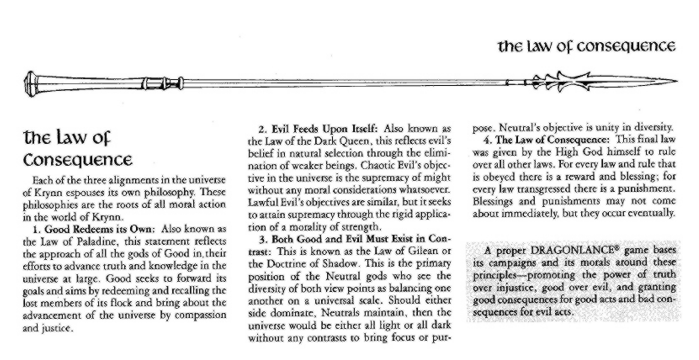
“The Law of Consequence” from the Dragonlance Adventures sourcebook (1987), which describes the moral and theological architecture of the world of Krynn.
In the Book of Mormon, ancient empires on the American continent, settled by Biblical wanderers over the course of millennia, inevitably began with a holy man or king who is humble before the Lord: a wise leader, and a true servant of God. But, inevitably, history unfolds with wicked men gradually taking power, tempted by the impulse to conspire Satanically in what the Book of Mormon regularly calls “secret combinations,” driven by avarice or a lust for power and conquest. The Seekers, secretly working with the Dragonarmies, are a perfect example of this Mormon trope; so too is the Kingpriest’s hubris in cleansing and exterminating the so-called “evil” races, as is Takhisis’s conspiracy to not adhere to the Krynnish gods’ agreement to abandon the people of Ansalon, plotting her return to conquer the face of Krynn with evil dragons and her Draconian troops. If ethnic conflict and migration shapes post-apocalyptic Oerth, and lost ancient magic and its brutal exploitation of the natural world underpins Toril’s calamity, the spiritual war in Heaven is the force that moves Krynn through its historical recurrence of destruction and creation.
These struggles to rise again after societal collapse, the dynamics of history and catastrophe, and the detailed (maybe even overdetailed!) legends and lore underpinning the action is what made these campaign worlds so compelling to me and thousands of other AD&D players: broad strokes with enough detail to allow the game masters and players to make some corner of these worlds their own. Gygax, Greenwood, and Hickman’s common use of an apocalyptic event reflects the deep beliefs and aesthetic inspirations and choices about what AD&D is fundamentally about, as well as the game’s threads of influences, literary and historical and religious. The adventuring party’s struggle, from penniless level 1 novices with rusty swords and shields to their eventual triumph as “name-level” lords, archmages, and high clerics, is a recapitulation of the broad historical pattern that all three creators perceived: a rising from a so-called post-apocalyptic “dark age” back to a renaissance, imitating an ancient empire’s high point.
Obviously, Tolkien’s history of Middle-Earth looms large in all three worlds, apart from the medieval, Third Age-like status quo. Tolkien’s history of Middle-Earth features huge, sweeping changes in the world’s politics and even complete revisions of its geography and physical shape, triggered by divine interventions, wars, and the misuse of magical treasures unleashed to wreak havoc on peoples and nations. We must also remember that Tolkien’s Arda is our Earth in a mystic, forgotten past golden age. Tolkien was not afraid to brush away the pieces he had set up on the “table” and start again clean, re-imagining and re-examining the demands of his narratives’ central moral mythology in a brand new set of political, racial, and social environments.
I believe this impulse to examine the eternal nature of moral and political questions alongside the “end of the world” is a big part of the post-apocalyptic aesthetic in these AD&D campaign worlds. “Apocalypse” in the West is a term that implies revelation, of course: that history’s purpose will be made clear in the tribulation of the eschaton, or final age. When we consider the real world’s proximity to a pair of empires ending the world in a “rain of colorless fire” in the 1970s and 1980s, when we look back on the harbingers of environmental damage and collapse, provoked by greed, pollution, and exploitation of the natural world, that occurred during the same time, and when we think about the premillenial religious dimension to the specter of apocalyptic destruction in the same time period, the specific dimensions of Gygax, Greenwood, and Hickman’s world-shattering disasters make so much more sense. These architects of fantastical world-sized playgrounds could not help but reflect the ambient mood of a world dangerously out of balance.
What comes after the end of the world? Perhaps a place where individuals can band together, start over again, and make a difference, whether that’s defeating ancient evils or merely carving out some kind of safety and power from a wilderness filled with eerie ruins and bloodthirsty beasts. It’s the same impulse that post-catastrophic fiction has always offered: the paradoxical hope that comes out of experiencing a collapse and then rebuilding of society, taking back “control” of the world and of history. It’s long been said D&D is a power fantasy. What better and more meaningful goal than to struggle against the end of the world (which has conveniently happened already!) and the monsters it unleashes?
 Michael Grasso is a Senior Editor at We Are the Mutants. He is a writer, museum professional, and a lifelong Bostonian. You can follow him on Bluesky at https://bsky.app/profile/mutantsmichael.bsky.social.


