By Michael Grasso / October 27, 2026
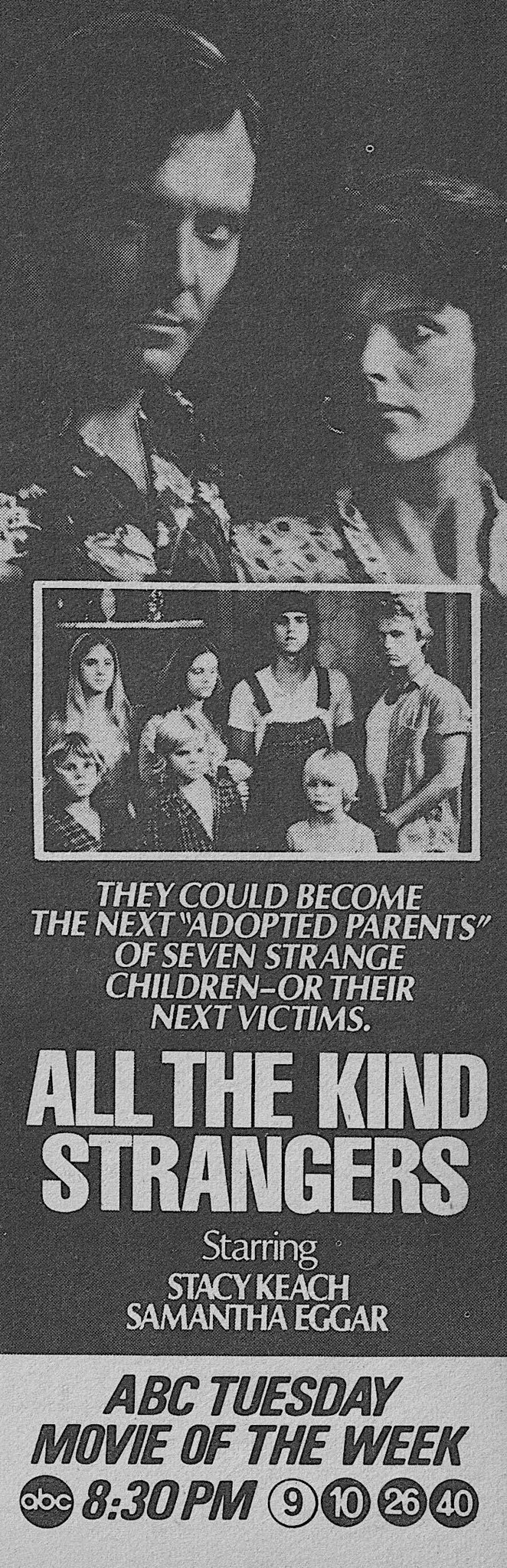 All the Kind Strangers
Directed by Burt Kennedy
ABC (1974)
A square-jawed man in a Hawaiian shirt drives his brand new convertible into a small town on his way cross-country. He comes across a young towheaded country lad carrying some heavy groceries on a multi-mile walk home and offers him a ride. In the 1970s, era of hitchhiker murders and serial killers, it’s safe to say the opening scene of November 1974 ABC Movie of the Week All the Kind Strangers carries with it some unpleasant undercurrents, but it’s actually amiable photojournalist Jimmy Wheeler (Stacy Keach) who’s going to end up trapped in a backwoods hell after being enticed to the home of young Gilbert (Tim Parkison).
Wheeler meets Gilbert’s family—or, more accurately, siblings—and soon discovers a heavy layer of creepiness surrounding the family farm and its inhabitants, which include seven children and several threatening guard dogs. Eldest son Peter (John Savage, who would go on to play the tragic role of Steven in 1978’s The Deer Hunter) exists at first only as a feared presence as Wheeler meets Gilbert’s sisters—younger Rita (Patti Parkison) and elder Martha (Arlene Farber), who is mute—and brothers James (Brent Campbell), feral youngest child Baby (John Connell), and brown-haired, sensitive John (Robby Benson, whose teen idol fame allotted him the right to sing the TV movie’s self-titled theme song). The children meet Wheeler with flat emotional affects and an odd, stilted reticence; Keach portrays Wheeler’s friendliness curdling into suspicion with great skill. When the feared Peter finally appears in the house after doing his farm chores, he offers Wheeler dinner and a place to stay, but Wheeler has to keep moving on to get to Los Angeles for a new job. When Wheeler’s brand-new convertible can’t turn over after having gone through a creek to get to the farmhouse, he reluctantly accepts Peter’s invitation.
It’s only at dinner that the fragmentary stories the siblings have been telling start to definitively not add up. Previously Wheeler had been told that Baby had that name because “Ma died when he was born. So he didn’t get no other name.” But soon Wheeler goes into the farmhouse kitchen and discovers an incongruously British-accented “Mama” (Samantha Eggar) making biscuits. As Wheeler observes that “the windows are nailed shut… and what’s a bolt doing on that door… on the wrong side?,” the woman audibly keeps up the “Mama” act so the children in the dining room can hear her, but frantically scratches the word “HELP” in the flour, erasing it before the siblings return to the kitchen.
All the Kind Strangers unfolds in the way you’d expect such a thriller to do in its second and third acts. Yes, these kids were orphaned: their original “Mama,” a local schoolteacher, did indeed die in childbirth and their father, a bootlegger, perished in a drunken fall from the roof. Left with plenty of money and supplies, the siblings are able to live without outside work, enabling their isolation. The kids’ dead alcoholic father is still a heavy presence hovering over the home, though, and it feels like Peter has taken the patriarch’s brutal lessons hardest to heart. The kids periodically capture new “parents” to take care of them, so far avoiding the eyes of police and social services. (Some modern reviewers seem to cite this unbelievable state of affairs as a “plot hole,” but in the era of “hicksploitation” films from Deliverance (1972) on down, depicting America’s rural wildernesses as full of backwoods torturers and murderers, this seems more like an essential point the film is expressly trying to get across.) Yes, Wheeler and “Mama” (whose real name is Carol Ann Henderson) try several times to escape the children and their twisted hospitality and love, but are stymied by the religious and familial brainwashing wrought by Peter, the pack of vicious dogs, and various primitive traps laid around the farmhouse property.
There are definitely moments where the telefilm surpasses its hokey premise. Keach’s reliable charisma anchors the cast, even though he lays on the “pampered urbanite” a little thick when he whines after his valuable cameras and car. There are also flashes of inventive camera work (whip-pans, sudden zooms) that show off director Burt Kennedy’s career experience penning and directing workmanlike Westerns; the showdowns (which consist of Keach and Eggar getting repeatedly caught trying to escape) may not have the gravity and drama of a high noon main street shootout, but Kennedy does his best with the bland setting of the falling-down farmhouse to milk some decent tension.
All the Kind Strangers also seems to have helped birth a genre all its own centered around isolated, cultish “lost children”—from Stephen King’s short story “Children of the Corn” (1977) to 1979’s classic of suburban anomie Over the Edge to David Cronenberg’s The Brood from the same year, in which Eggar becomes mother to a mutant horde of violent children—that gave voice to the worry that Seventies America was raising a young X generation that could only find a sense of identity and certainty in feverish loyalty to each other in violent opposition to the oppressive adult world. In this light, Savage seems to me to be the real star of the piece, asked to shoulder the burden of portraying Peter’s complicated traumatic past, which has possibly turned the boy from a sensitive young man into a murderer, all while remaining an incongruously cherubically-faced “heavy” against the already very heavy Keach. Benson almost seems like he doesn’t belong; his sassy, sarcastic manner screams Middle American suburban brat far more than “socially isolated country boy.”
As mentioned above, the threads of hicksploitation/Western tropes and generational ennui running through All the Kind Strangers are patently obvious, but for my money the most interesting socio-political ’70s element of the film is how much it recapitulates and echoes the cultural currents at play near the end of the Vietnam War. Saigon would fall in a few short months, and those punji sticks and tripwires surrounding the farmhouse property—along with the baby-faced, laconic “natives” terrorizing Wheeler and Carol Ann—give decided Viet Cong guerilla fighter vibes. “I’ve survived Vietnam, a rotten marriage,” Wheeler tells Carol Ann as they try to figure out how to psychologically outwit the children: “I’m indestructible.” The key to finally getting Peter to relent is Wheeler sensing his desire to get out and see the world, to widen his horizons: “I read about California and New York. I’ll be going there myself someday,” Peter proudly says to Wheeler in an unguarded moment near the beginning of the film, after Wheeler tells Peter about his photojournalism job.
From the outset, it’s clear that Peter is too young to take on the mantle of “father,” that he has been thrown into what he presumes is “adulthood”—ruling his family with a stern patriarchal fist—before he was ready. Torn between his assumed responsibility to family and his resentment at being turned into a killer by his father’s abuse, Peter understands, thanks to Wheeler (his surrogate dad) and Carol Ann’s help, that the best solution is to turn himself in to the authorities and get the kids some social services help: no more psychological torture, no more prisoners of “war,” no more cruel fathers. Sometimes, it seems All the Kind Strangers is trying to tell us, the best solution to an intractable, violent conundrum is simply to decide that the lies we’ve been fed by our abusive fathers are too much, realize we’ve been in the wrong all along, and surrender.


