By K.E. Roberts / August 12, 2026
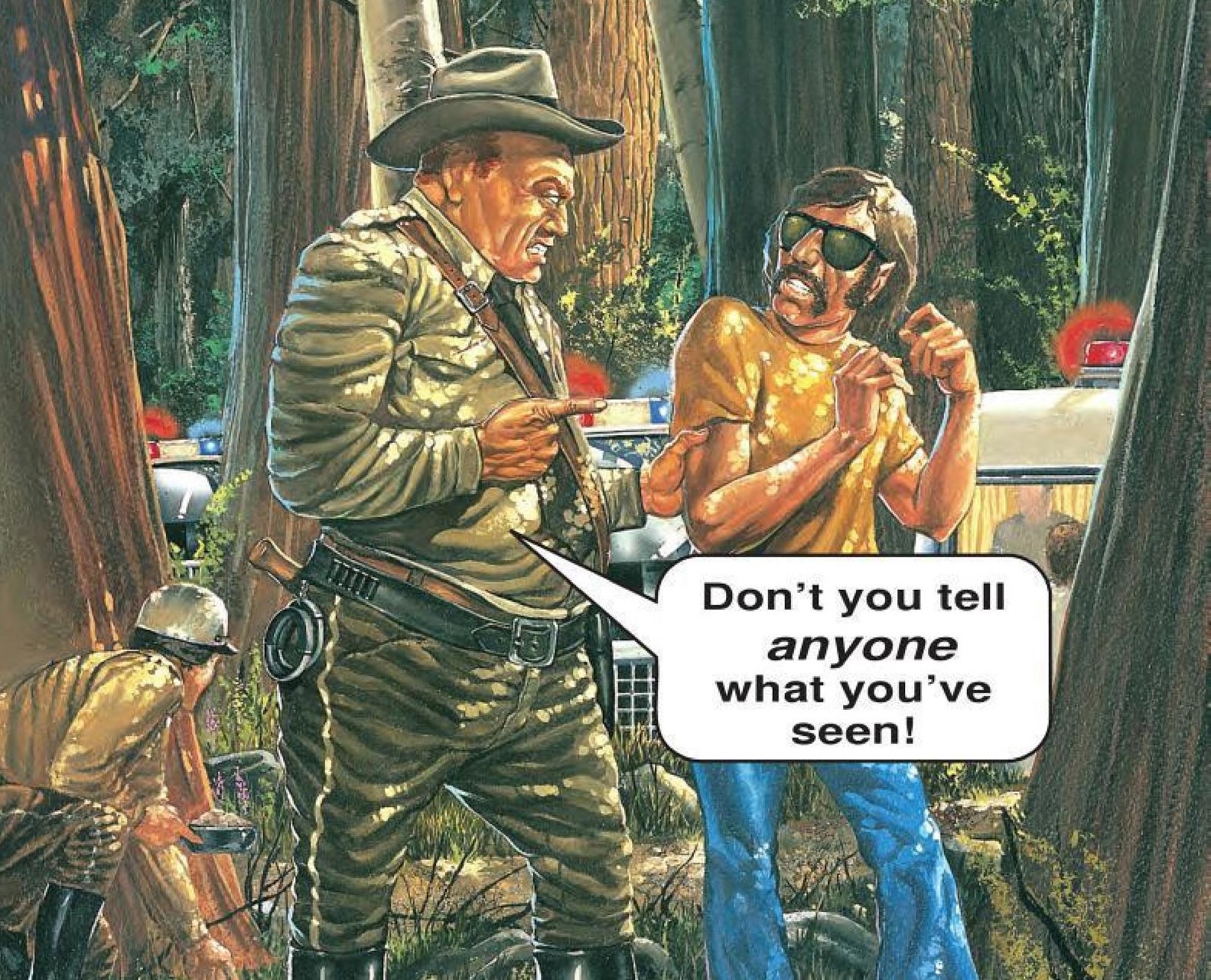
I grew up in the San Gabriel Valley of Southern California, only a few miles away from Jack Chick’s headquarters in Rancho Cucamonga. His fundamentalist Christian “Chick tracts” were everywhere in the 1970s and early 1980s, and my friends and I giggled at the brilliantly succinct fables even as we secretly trembled at the consequences of being “unsaved.” The first one I remember reading was 1964’s This Was Your Life!, about a “good man” who is cut down in the prime of life—actually cut down by the grim reaper himself! In a series of compellingly illustrated panels, we see his spirit rise from his body and the grave and travel with an angel to the place of judgment, where he finds out that everything he’s ever done has been recorded and must be reviewed. It turns out the man wasn’t so good after all—he told a dirty story, ogled (and possibly masturbated to) an attractive woman, and wondered “who won the ball game” in church—so he’s summarily cast into “the lake of fire” for all eternity. It’s an incredibly miserable dogma to have to drag through life, a hell in itself, and in the end I just wasn’t scared enough: there was too much heavenly sunshine and too many places to race and jump my beloved Schwinn Scrambler.
In 1974, when his tracts were at their peak, Chick premiered a series of full-sized, full color comic books called The Crusaders, written by Chick and illustrated by Fred Carter, a Chicago reverend who moved to California in ‘72 to work with Chick. Volume One, Operation Bucharest, introduces 21-year-old Tim Clark, a former Green Beret war hero who was saved on the battlefield by missionaries and became “a radiant Christian,” and James Carter, a former “bad dude” and “expert in street fighting trained as a black militant” who found Jesus thanks to the old neighborhood preacher. Carter is black, obviously (as was Fred Carter), and Tim is white. These are your Crusaders, and their first mission involved smuggling bibles into godless, communist Bucharest. Their second adventure happens in the mind-bogglingly absurd but profoundly entertaining and historically notable The Broken Cross (also 1974), which follows our heroes as they uncover a satanic occult conspiracy in an unnamed Northern California town. The comic foregrounds Chick’s particularly virulent and extremist brand of Christianity—many of his tracts have been rightly classified as hate speech—and marks a very early foreshadowing of the Satanic Panic of the 1980s and early ‘90s.
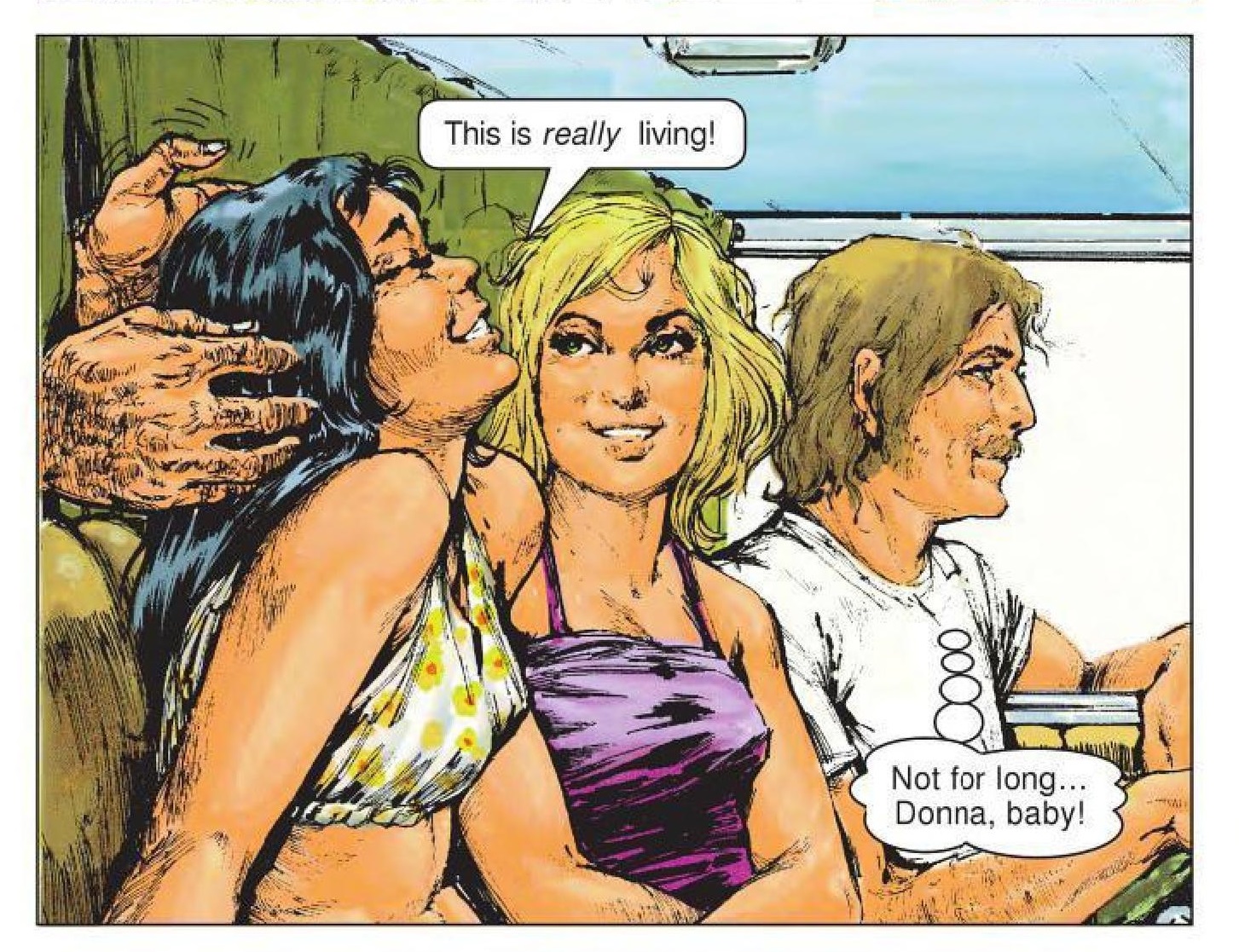
Our story starts with that most hippie of hobbies—hitchhiking. 14-year-old crop-topped Donna is hitting the road and “free at last,” looking for a ride to Los Angeles. She’s picked up by a young couple in a funky green van who establish that she’s “splitting the home scene” because her parents “are trying to cram church down me,” that she’s all alone, and that she has nowhere to go when she gets to LA. Bad idea, Donna. Two hairy and depraved henchmen yank her into the back of the van and drug her, and the kidnappers jet off to a black mass, where Donna is sacrificed to Lucifer and the witches’ coven drinks her blood. “With all these girls thumbing,” Satanist Bobby exclaims, “we’ll have an endless supply.”
Hitchhiking was an explicit “rejection of a middle-class lifestyle” for counterculture youth, a rejection that included mainstream religion, and by the early ‘70s mainstream media and law enforcement were proclaiming that young women who did it “practically invite rape”—or murder. Chick’s linking of hitchhiking and occult sacrifice might have originated with the murder of 15-year-old Carolyn Davis in Northern California’s Garberville in 1973: Sheriff Don Striepeke believed that a series of murders of young female hitchhikers, including Davis, were the result of “witchcraft” (an “ancient witchcraft symbol” was allegedly found at Davis’s crime scene), and sensationalist headlines abounded. In a similar case in New Jersey, 16-year-old hitcher Jeannette DePalma, who was allegedly “definitely involved in some occult things” and had vowed in her diary to “stop smoking weed and give herself to Jesus,” was found dead on a cliff the locals called “the Devil’s Teeth” in September of 1972. The town pastor believed it was the work of “devil worshippers,” and several news reports referenced “human sacrifice.” These allegations were later proven to be a hoax, or rumors that became urban legend; the hysteria over “black magic” and Satanism was already setting in.
Enter the Crusaders, who arrive as the police find Donna’s body drained of blood. Carter thinks it “sounds like the occult,” but the cigar-chewing sheriff thinks he’s an “idiot” and makes them move along. He’s in on it too. They get similar results from the town’s “very liberal” pastor, who denies that the Bible is the word of God and is later seen lighting a black candle in preparation for a malicious hex. Next stop: the library, where all the books on the occult have been suspiciously removed! On the way to the library in the next town (why do they need books to confirm what they told the sheriff and pastor they already know?), they nearly run over a depraved lunatic who’s eating human fingers (“CHOMP CHOMP”) in the middle of the highway: “satanism in its worst stage,” says Tim. A note at the bottom of the page claims that “Such an incident was reported in the Big Sur area in California, 1973.” Other than the date, Chick got this one right: in July of 1970, Stanley Baker killed James Schlosser, a Montana social worker, and “cut his body into six parts and ate the heart.” When picked up two days later by the Highway Patrol close to Big Sur, one of Schlosser’s fingers was found in Baker’s pocket: “I have a problem,” he said, “I am a cannibal.” He claimed he was part of a satanic cult and committed the murder to “worship… the devil.” He later said he did it because of an LSD-induced rage at “the establishment.”
“Back at the motel,” Jim regales Tim with the story of Lucifer’s rebellion, Adam’s fall, the great flood, and the iniquity of Babylon. Bible study ends abruptly when Tim claims that the “religion of witches called the Wicca” originated in Ancient Rome (as opposed to 20th century England) and that the Wiccans were later “overshadowed by a group of Luciferians called The Illuminati,” a nefarious global network hellbent on world domination. This conspiracy theory appears in much of Chick’s work and comes from a friend who is acknowledged at the beginning of The Broken Cross: “My deepest appreciation to John Todd, ex-grand Druid priest, for the authenticity of the occult information used in this story.” Todd, a frequent speaker in evangelical circles in the ‘70s, was a con man and compulsive liar who played unholy occultist and devout Christian in equal measure, mainly, it seems, to find impressionable young women to sexually harass and abuse. While on probation for charges of incest, Todd was convicted for rape in 1988.
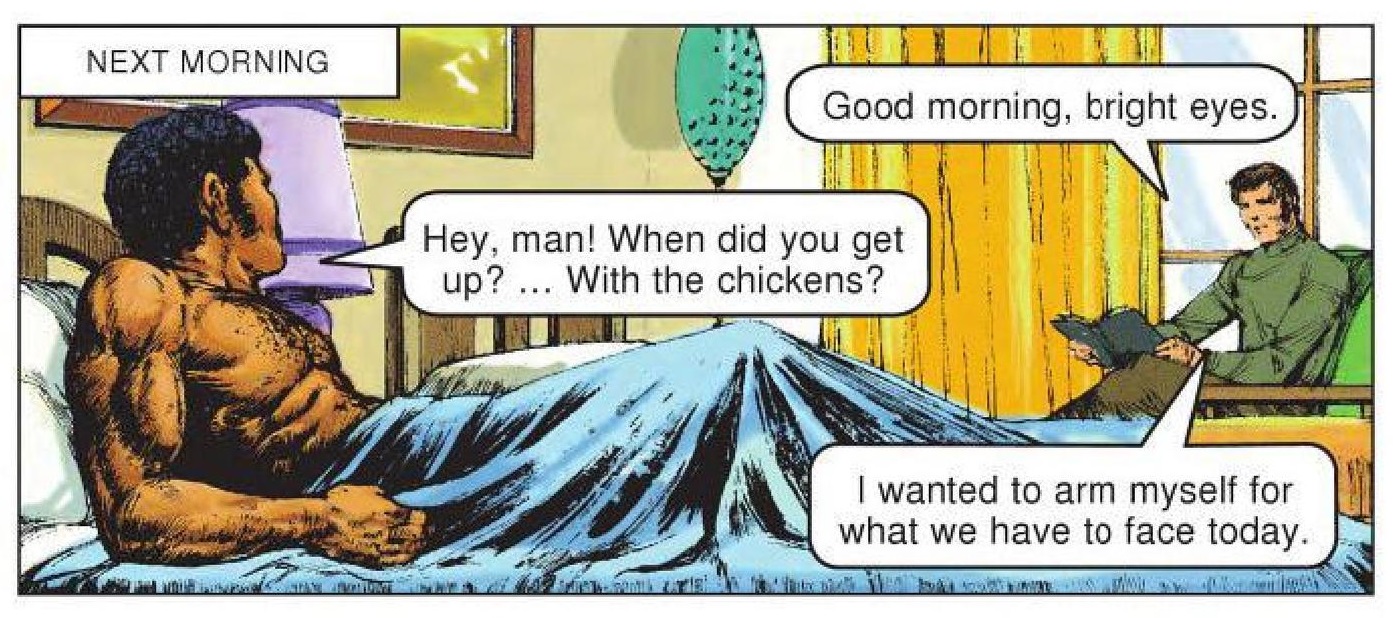
The illuminati, Jim continues, were responsible for Jesus Christ Superstar and Godspell (both theatrical productions opened in 1971), which “discredit the Lord.” As Tim takes his shirt off in dramatic fashion, revealing an incredibly detailed and muscular physique, he asks about 1973’s The Exorcist. Predictably, because Chick wrote that Catholicism was “an evil global system” and the Pope was “the antichrist” and “the Whore of Babylon,” Jim isn’t into it: “The film was slanted to show Jesus was powerless against the devil.” Skip to the next morning, as shirtless Jim props himself up in bed. “Good morning, bright eyes,” says smiling Tim, who is reading his Bible to “arm myself for what we have to face today.” The homoeroticism is so apparent—throughout the comic, the square-jawed Crusaders wear skin-tight shirts that can barely contain their bulging muscles—that I have to wonder if it was an intentional decision, or perhaps a subconscious expression. Chick himself repeatedly excoriated homosexuality as “filth and brutality,” “demonic,” a “perversion” and “abomination.” Whatever the case, all credit goes to Carter’s convincing art: not only is he far more talented than Chick, but he could have held his own in the wider comics market of the time, which he had surely studied. His work reminds me of the contemporary output of Neal Adams, Richard Corben, and even Frank Frazetta.
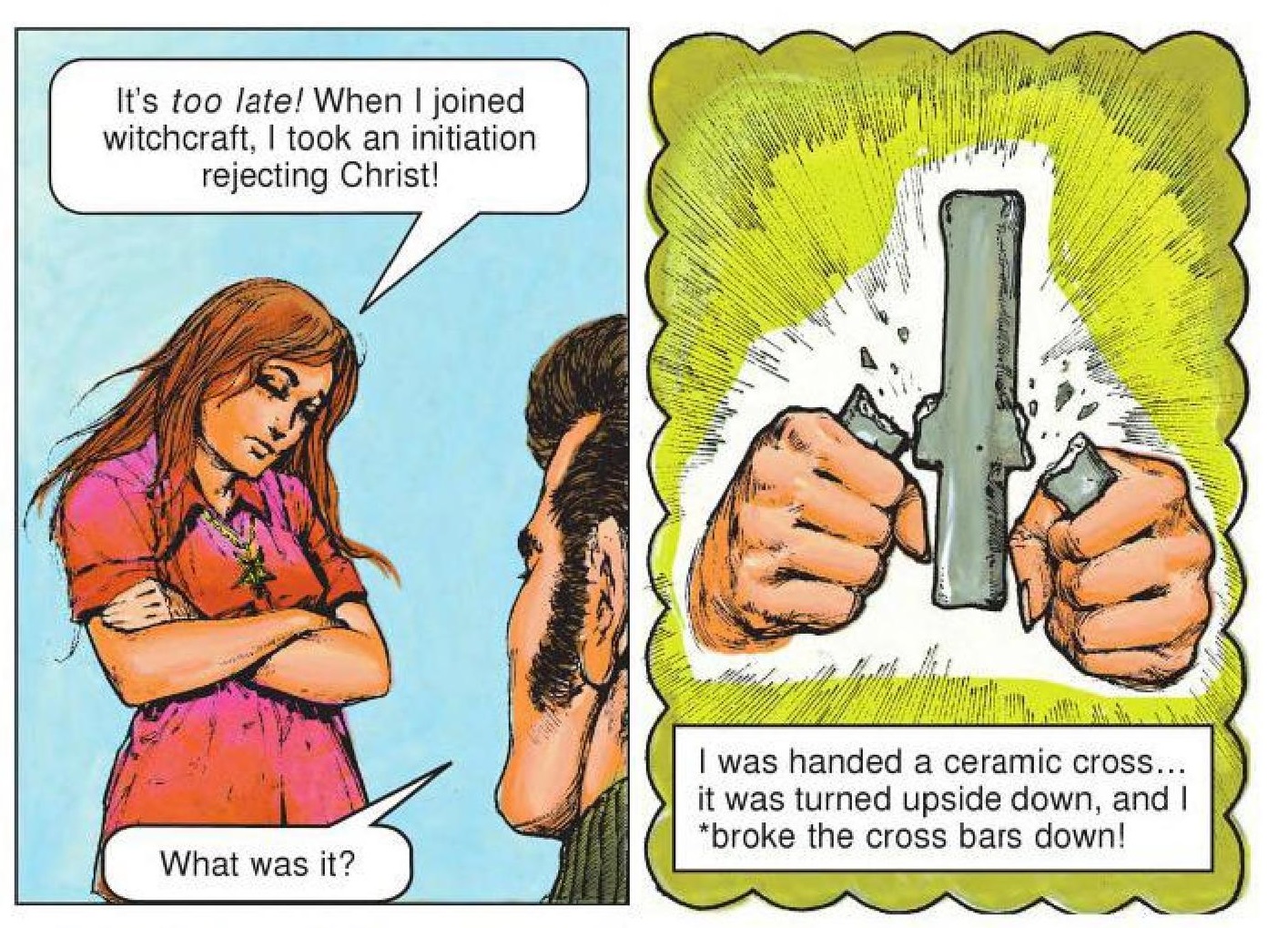
Before Tim and Jim “storm the gates of hell,” they load up on breakfast at the local diner, where they meet teenage Jody, who’s wearing a pentagram and claims she’s a witch, like “80% of my school.” One of her teachers introduced her to “Lucifer’s fantastic power,” which allows her to control everything except “some stupid Jesus freaks.” The Crusaders break into their sales pitch on getting right with Jesus, but Jody says it’s too late: she broke an upside down ceramic cross and rejected Christ during her witchy initiation. Next to a small peace symbol at the bottom of the page, Chick writes that “The inverted broken cross” is actually “the symbol of anti-Christ.” This is yet another conspiracy theory, or hoax, that runs through Chick’s comics and dates back to a 1968 flyer (“Their Peace Symbol – ‘The Broken Cross’”) that was reprinted and disseminated by a number of far-right groups, including the Network of Patriotic Letter Writers (NPLW) and the Ku Klux Klan. The campaign, clearly designed to discredit and malign the American anti-war movement, was solidified in a June 1970 article from the John Birch Society’s American Opinion magazine. Author David Gumaer falsely claims that the peace sign (designed by Gerald Holtom in 1958 for the Campaign for Nuclear Disarmament) is a “Communist insignia” and “prominent anti-Christian symbol” that was emblazoned on the shields of “Saracen hordes” in 711 A.D. and is part of an overall “resurgence of satanism, and the proliferation of black magic shops in areas where leftist students and radicals gather.”
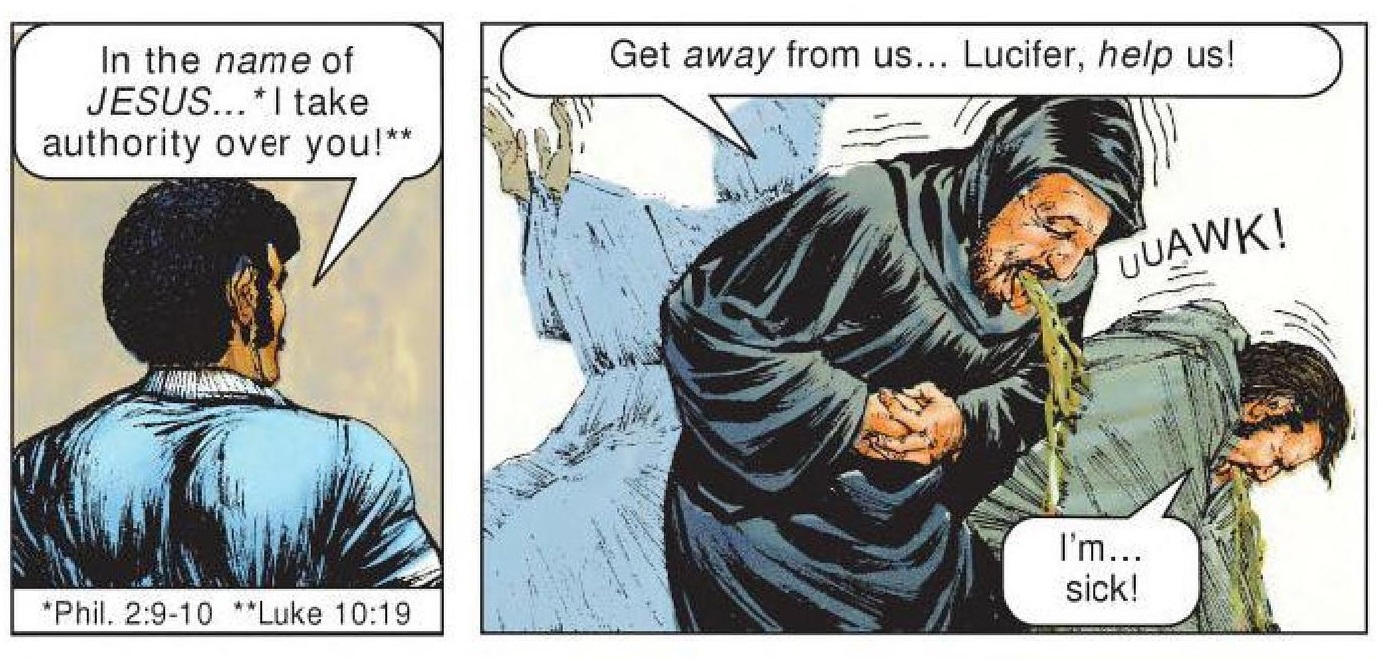
Jody is reluctant to accept Jesus until Jim tells her about some additional, one might say carnal and decadent, perks: “riches and power like you never dreamed! You would have angels waiting on you… travel in your new beautiful body at incredible speeds.” Unfortunately, minutes after she’s born again, the Satanists kidnap her in the same green van that got poor Donna and prepare her for sacrifice. The Crusaders track her to the site of the black mass and Jim kicks the door down. His superhero muscles are totally unnecessary, however; all he has to do is invoke the name of Jesus and the black-robed evildoers start to vomit uncontrollably! The leaders of the coven—sheriff, liberal pastor, even the mayor—are rounded up and arrested like it’s the end of a Scooby-Doo episode, and Jody, safe and sound, thanks the Lord “for the precious blood of Jesus Christ!”
Clearly, Jack Chick is very concerned about young people, especially young women, especially young women who want to be free from controlling parents and pastors, dabble in the occult, and wear or sympathize with the peace symbol, which inevitably, perhaps subliminally, bends them to witchcraft and communism. But wherefore this full-blown hippie-occult emergency? All accursed roads lead back to Charles Manson. After the Tate-LaBianca murders in the summer of 1969, headlines swept across Southern California newspapers proclaiming “Ritual Killings” and an “Orgy of Murder” perpetrated by a “Savage Mystic Cult.” Joan Didion famously described her reaction to the Cielo Drive slayings (Tate and Polanski were her friends) in a 1979 essay called “The White Album”:
Black masses were imagined, and bad trips blamed. I remember all of the day’s misinformation very clearly, and I also remember this, and wish I did not: I remember that no one was surprised…
This mystical flirtation with the idea of ‘sin’—this sense that it was possible to go ‘too far,’ and that many people were doing it, was very much with us in Los Angeles in 1968 and 1969… The tension broke that day. The paranoia was fulfilled.
The idea that the Manson murders were inevitable, given that a good part of an entire generation had disowned the institutions, ideologies, and traditions of their forbears, has become a truism, but it’s not exactly true. Poet and activist Ed Sanders wrote in 1971’s The Family, the first published account of how Manson and his lackeys became murderous thugs, that “There were no rules. But there was a weakness… the flower movement was like a valley of thousands of plump white rabbits surrounded by wounded coyotes.” Yes, but what of our obligation to protect the rabbits, no matter how wild? And what happens when the wounded coyotes are the lawful protectors? While much of the book is a harrowing account of his experiences researching and infiltrating the Family, much of it is innuendo and speculation: Sanders ultimately wants to link Manson to an alleged satanic underground to rescue the hippie movement from ignominy. The last line of the book does not back down: “And only when all these evil affairs are known and exposed can the curse of ritual sacrifice, Helter Skelter, and satanism be removed from the coasts and mountains and deserts of California.”
Chick and what would become a consortium of evangelical, fundamentalist, and Catholic ministries did not take this account lightly, bolstered as it was by opportunistic media and shoddy law enforcement. Anti-cult and anti-occult campaigns were launched across the country, intersecting with the ongoing stigmatization of rock ‘n’ roll as “the devil’s beat.” (In The Crusaders Volume 10, 1978’s Spellbound?, Chick takes on the Illuminati-controlled rock industry and urges teens to burn all their records.) It was a war for souls that’s still being waged, but it was also a struggle for control over the minds of young people like Donna, who, in the words of a hitchhiking guide from the ‘70s, had “gone off to look for America in hopes of finding a small corner of it that isn’t plagued with the authority, hatred, and greed that is the underlying principle of the capitalistic system.” Is it her unsaved soul that so outrages Chick and his cohorts? Or is it her ecstatic exhortation that she is “free at last”?
 K.E. Roberts is Editor-in-Chief of We Are the Mutants and a freelance writer. He lives in Los Angeles and will never own a house.


I wonder if chicks works have not already been satirized on late night TV. Say for the example of adult swim from the cartoon Network. There is plenty of material in their comics for that I think.