Features / August 31, 2026
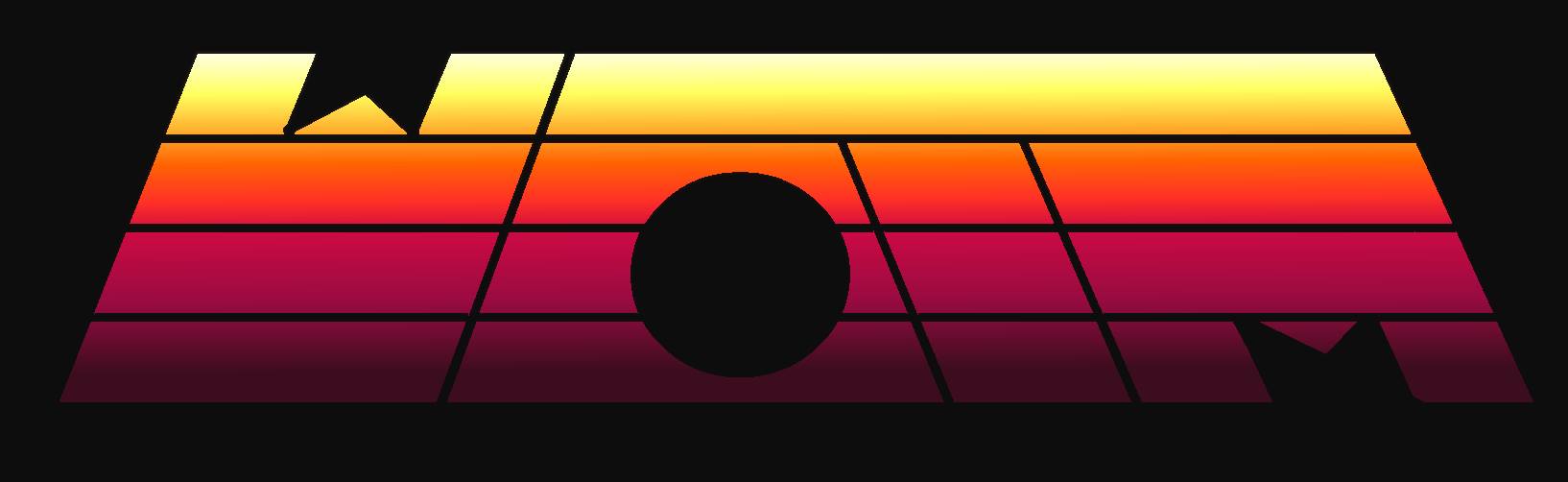
Original design by Richard.
ROBERTS: Jesus, 10 years. Launch date: August 29, 2016. Since then we’ve published almost 600 articles: many of them, in my opinion, are important contributions to cultural history and culture at large. Some of them are definitive takes, although I’m not sure we’ll ever get that credit. There’s no peer review here, no corporate or academic overseers (thank Christ)—just three aging humans who are uniquely, obsessively inspired by the mass culture of a particular time and place. It’s partly nostalgia—we all admit it and talk about it constantly—and it’s partly the belief that the odd, half-buried artifacts we dig up and think about and write about actually matter to the world and deserve your attention. But maybe that too is nostalgia. Maybe we as a species have evolved (evolution is non-progressive) beyond the need or desire for art and media—yes, why not call it ”content”?—that cannot be easily scrolled or binged or assimilated into our ever-narrowing attention spans and our dogmas that ossify a little bit more with every howl and click on social media. How could one write a space opera on a keyboard in a garage in such conditions? Why would anyone want to? Okay, okay, this is supposed to be a celebration! I need to calm my old ass down. Weird, interesting stuff is still being made and the future is bright. Right?
MCKENNA: Fucking hell, 10 years. That’s an actual chunk of a person’s life. If WATM was a kid, it could be getting the bus to school on its own. And without wishing to get too chronocentric about it, I think it actually has been a pretty uniquely weird 10 years from a political—and for me at least from a personal—perspective too. In terms of local stuff, the UK’s cycled through about 60 prime ministers, and where do you even start with the US? And the rest of the world? Add to that the things that were purely the province of science fiction when we posted our first post are now the stuff of conversations with my next door neighbor while we take the bins out. But fuck, we’re still doing it! Is that healthy? When all the aforementioned world stuff is going on, is there any justification for a trio of people in their fifties to still be obsessing over things, often very marginal things, that happened or were produced many decades ago? It’s a question that has frequently nagged at me while we’ve been doing this. Is there more to this than just me taking an indulgent soak in the soup of my memories? Shit—now I’m being a downer on the celebration. But I actually think that there is more to it. Right, Mike? Right? Tell me that there’s more to it!
GRASSO: I want to start off—because if I crack straight into describing how fucking weird life has been over the past 10 years, I might be here for 10 more—with a message of gratitude: Kelly, to you for answering my nerdy fan letter 11 or 12 years ago that started our correspondence; and Richard, to you for always tolerating my obsequious fascination with Britain in the ’70s and ’80s; and to both of you for being great colleagues and even better friends this past very tumultuous decade. Now that that’s said: wow was my life different in 2016. I was starting this magazine with you guys, I was producing two now-defunct podcasts, and I was simultaneously getting my Master’s degree and working in an amazing museum part-time, learning the ropes of the profession. Whoo boy, a lot has changed since then, which I’m sure we can talk about. But Mutants, and you guys, have been the rock and the lodestar I can always return to.
When I first read 2 Warps to Neptune, I could sense Kelly wanting to go longer, deeper, further afield with his already excellent takes on nostalgia and the media objects of our youth, and to be part of that evolution… man, I’m just like the luckiest guy around. WATM made me as a writer. Kelly and Richard’s editing made me a better writer. Our readers, fans, collaborators, and correspondents made me a smarter writer, and the people I’ve met and worked with thanks to this magazine have expanded my horizons beyond anything I could have hoped at the outset of my forties. I joined you two in the fifties club last year (yup, I’m the annoying little brother of this fraternity, in case any readers did not know that!), but I could keep talking about this stuff for another decade. Kelly, give us some thoughts as the founder and our editor-in-chief: what did you have in mind for Mutants back in 2016 and how did that change over the past 10 years?
 ROBERTS: Well, I wanted to do something that wasn’t being done. That was the first goal, and I think we hit it very early on. I wanted lots of different voices, and we’ve published around 75 different writers. I’m proud of that. Even though I’d love to keep taking submissions and pitches, the problem is that I just don’t have the time anymore. If there’s one thing that’s changed over the last 10 years, that’s it: time gets shorter and shorter. My day job hasn’t gotten any easier, and my kids are in middle school and starting high school. I’m a chauffeur, a coach, a perpetual pesterer and grocery shopper and laundry doer—just like so many other parents out there. And because I’m 10 years older, I’m 10 years more tired than I used to be! Also, thanks to our generous supporters, we got to a point where we were able to pay writers (not us, unfortunately), which was important to me. But that became a big source of anxiety: I felt pressured to produce consistently and at a high clip, and that wasn’t always possible; and the subscription platforms were a pain for me to manage (as is anything related to site maintenance). So, for now, it’s just us. And I kind of like that. Getting the Mutants chat going again has been a real lifesaver for me. (Having said all that, if you do have a great idea and want to pitch it, send that pitch to watm@wearethemutants.com. No promises.)
As for the direction of the site, we’ve talked about expanding our scope for years. The only thing holding us back, I think, is me. We do talk about contemporary stuff occasionally—Mike’s review of the new Boards of Canada LP is a recent high point (although maybe that’s cheating: BOC seems to be as uniquely and obsessively inspired by the same culture and time period as we are)—but I just can’t see myself writing about the latest A24 release, Geese, The White Lotus, the newest podcast: I like some of it, but I don’t love any of it. Plus, you almost have to be rich to get anything made today, and the stink of privilege makes for boring art. To me, anyway.
Should we still be doing this after 10 years? Why not? We should all be putting the energy that we have left into the things we care about.
MCKENNA: Well, that kind of neatly brings me back to the question I asked earlier that you two rakishly sidestepped like it was a hot glistening turd freshly deposited on a Phoenix sidewalk: after thinking it through, I actually do think WATM is something that’s worth three adults spending their time on—a conclusion that’s a bit like a judge finding himself innocent of tax fraud, I admit. But quite apart from the fact that raking over all this stuff is genuinely a huge amount of fun to do (despite Kelly’s ongoing attempts to drive me insane with his “edits”) and that I love getting to shoot the shit about it with you two, even on the rare occasions I do find something less than 40 years old that stirs something within me, I’m hardly in an ideal position to have the kind of insight I might—emphasis on might—have into something that struck me when my antenna were less withered than they are now. And to be honest, I’m kind of opposed to this idea that looking at the recent-ish past with affection, skepticism, and scrutiny, which is what I hope we manage to do here, and examining the role the past has played in making us as people or societies what we are today, or even simply saying “this ephemeral thing has its own value unrelated to when it was produced,” is necessarily sterile nostalgia.
Scrolling back through the site, I was worried it might look like one of those “Do you remember Spangles?” things, where people genuinely do bask in the remembered glow of childhood and youth (no judgement, I’d be lying if I said I never did it), but I hope I’m not kidding myself in thinking we’ve avoided that? I don’t feel like we’re living in the past, I feel like We Are the Mutants is what I hoped it would be when we started: something that explains and contextualizes why this period and the things and events it produced still feel so compelling to us, for better or for worse, without either descending into fanboy atrocity or academic aridity. We haven’t done any unboxings yet, at least. Unless it’s been an unboxing of historical currents, badum-tishhh.
Like you, Mike, I first got involved in all this by writing Kelly a fan letter for his previous site—something that, if I’d known the decade-long avalanche of critiques of my paragraph-length sentences I was letting myself in for, I might not have pressed ‘“send” on—and then met you through us putting the site together. I don’t want to get all emotional, but it has been pretty magical. And on top of that it’s given me a fulfilling distraction through some pretty trying times, and also I think helped me develop a healthier relationship with the kind of stuff we deal with, processing out some of my slightly obsessive tendencies and allowing me to be more selective about what was actually good and beautiful in it all, as well as more aware of the strange threads running through everything. Which is why I’m writing this wearing a Moonbase Alpha uniform (red sleeve).
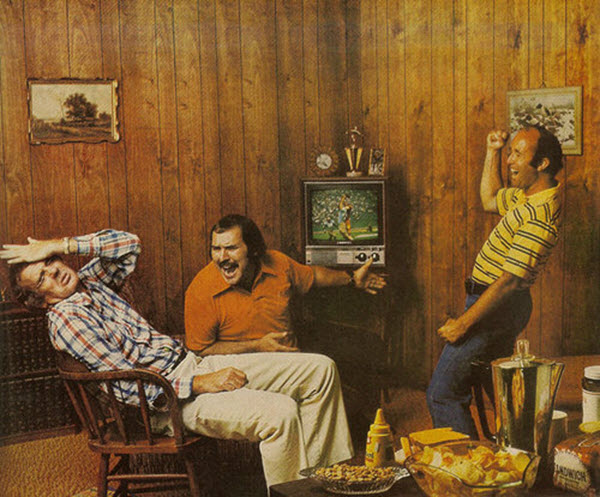
Here, in a photo taken at the We Are the Mutants rec room/strategic command center, Kelly (left) reacts to an article proposal from Mike (center) and Richard (right), probably about a former member of Genesis.
GRASSO: First off, I’ll just say that WATM has opened up to me the idea of a scholarship and a theory of nostalgia, a stumbling towards exactly why we feel those paradoxical and contradictory qualities of safety and… sickness when we look back on the media of our youths. I don’t think without Mutants I would have been drawn towards the work of folks like Svetlana Boym, Mark Fisher, Grafton Tanner—scholars who posit the idea of the past as something you can actually play with; memory and nostalgia’s golden poison then becomes a mutable, constructivist learning experience that contextualizes history, instead of enshrining the reactionary impulses of “RETURN” and “MAGA” that we’re all quite familiar with by now. (It is a trip to realize that our ascent has basically happened at the same time as Trump’s own reality-warping wish for Everything To Be The Eighties Again.) On that note, over the course of Mutants I have discovered how so much of what I idolized from “back then” is incredibly toxic to still be attached to (I feel like the overall sequel/IP-driven core of Hollywood is enough to make any self-respecting Gen-Xer sick… and yet those movies and tchotchkes still make billions), and yet that process of dialectic, of (self-)examination, allowed me at the same time to see how those cultural objects intersect with the larger material forces of history. All this stuff was a huge part of my Master’s work on museums, and while the degree examiners might not have “gotten” my use of nostalgia theory, I still think it’s an important aspect of cultural memory to explore.
I think for me the pieces that have stuck out have been the more personal ones! I think about Richard’s trip to the Planet of the Apes live show, of the many ‘80s arcana of Kool Kelly’s Place, of my own explorations of what PBS meant to me as a kid, or local Boston TV, or the old UFO documentaries and British folk horror series that scarred my brain. (It’s always TV with me, isn’t it?) I think we work great when we’re being serious, but I’ve also enjoyed just riffing on stuff in our round robins. (So what if Kelly wouldn’t join us for our lengthy testimonial to the genius of Phil Collins, Richard!) Every time Kelly suggested a made-for-TV horror movie from the ’70s or ’80s that I’d never seen (for our annual Halloween Tubular Terrors series), I was dubious about the prospect—and every single time I loved the hell out of them.
On that note, the stuff we did for Repeater Radio, our little video podcasts, ephemeral now and lost to the sands of time, were a lot of fun to do. Writing a book with you guys was a peak experience, even if the process just happened to coincide with some of the worst times for me over the last 10 years. (If I start by saying that my dad almost died of COVID the week the book came out, that would give you some inkling of what the entire year-plus of writing, editing, and publishing that book felt like.) I think I’m proudest of my Bernie Sanders piece (made instantly hauntological itself by Sanders’ crushing losses in 2020), my look at the infamous Episode 8 of Twin Peaks: The Return, and my piece on Thomas Harris’s Red Dragon as a harbinger of the so-called “New South.” Those three pieces really got at the core of what I’ve wanted to achieve with my writing for Mutants.
ROBERTS: I’ll leave Phil Collins and nostalgia scholarship to you guys. One thing I want to do before we wrap up is thank the thousands of people who scan, upload, and host (especially the truly invaluable Internet Archive) the books and comics and magazines and music and movies and games and commercials and generally out-there stuff that we talk about. WATM would not be possible without them. Google Books and the Google Newspaper Archives are also indispensable resources that I use in nearly every piece I write. I hope we can keep doing this! It’s been fun and meaningful and painful and frustrating all at the same time, but I suspect that’s how it goes for any pursuit that really matters. We’re a vanishing species writing for a vanishing species, but at least we’re not vanished. Not yet. I started this off by asking about the future, so give me your recommendations or insights from the last 10 years that give you some hope about the world to come.
One of the things I’ve noticed is that bookstores are making a comeback, both independents and chains; the Barnes & Noble I over-dramatically eulogized in 2019 reopened last year a few hundred feet from its original location. We make it a point to go with the kids at least once a month and, let me tell you, even though the shelves are not what they once were, it’s very nice to be among them again. The libraries in my neck of the woods have also expanded their hours and services, and we spend plenty of time there too. Now, as a society and a civilization, we just have to start reading the books.
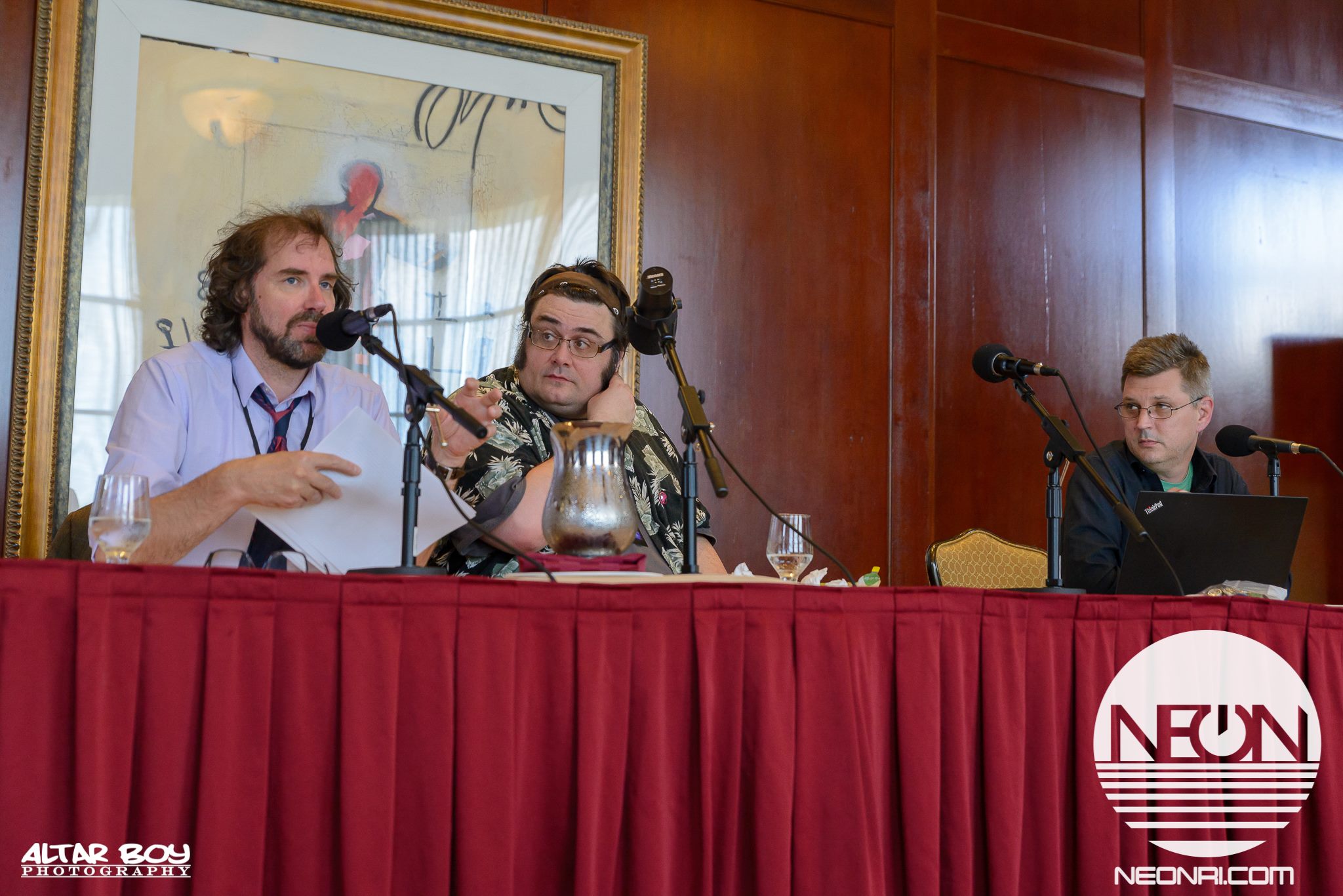
The editors at the NEON Retrofuturism Festival in 2018. Note Richard’s last ditch effort at having hair.
MCKENNA: I’m just realizing that I haven’t mentioned any of the things you two have done that I’ve liked best, but to be honest I’ve liked everything that all of us have done, because what I love most of all is the weird polyhedron they’ve created by all slotting into each other—just the crazed mass of stuff that has piled up and that I think in its trifling way represents some kind of contribution to understanding a period of history. I’m so gratified by the way the gradual accumulation of it all has become a living thing in its own right, and I’m sort of moved by the idea that we’ve made something and it’s the kind of thing that I would love to stumble on and click through. (Also Mike? Getting Collins in there—that was a moment of rare ecstasy)
Jesus, stuff from the last 10 years that gives me hope about the world to come—insert uncomfortable grimace emoji. I mean, I’ve not really been swimming in hope about the world to come since I first became obsessed with getting nuked into dust when I was about eleven, so I’m not sure I’m actually capable of thinking in those terms. I’ve seen a lot of cool films, and I feel like this wave of young horror filmmakers might do something interesting. I don’t think they’re there yet, but it feels like they actually want to make stuff that’s genuinely distressing. I’ve read a lot of cool stuff, listened to a lot of cool new music, but to be honest and without wishing to sound schmaltzy, the thing that gives me the most hope for the future is my Zoomer students. They’re so cool and funny and strange. Yes, they have loads of irritating mannerisms and fixations or whatever, but Jesus Christ, have you ever met a Boomer, or a Millennial, or to be quite frank, a Gen Xer? In comparison, the Zoomers are the least annoying cohort yet, and even when they’re extremely annoying they’re capable of seeing the absurdity of it all. Plus, without being beholden to them, they’re all entranced by the beauty of the ‘70s and ‘80s. So yes, my violently banal and pedestrian answer is, I believe the children are our future.
GRASSO: I was saying in my HILOBROW interview a little while back how I don’t consume a lot of new media content, and haven’t for, oh, about 10 years. Episodic TV has bored me for a while (never mind the fact it feels impossible to find new shows with all the streaming services out there) and COVID kept me out of cinemas for most of the 2020s. But still, there are some things I’ve seen since 2016 that have left an impact. On TV, I liked Severance quite a bit. I followed Succession when it was on but I’ve cooled on it considerably, whereas Barry has only grown in my estimation since it wrapped. Adam Curtis’s documentaries since HyperNormalisation (2016) have, I think, been uneven but they’ve all been appointment television. The last two movies I saw in 2019 before COVID hit were Uncut Gems and Once Upon a Time in Hollywood, and they both managed to make it onto my 25 desert island movies list, same as Mandy (2018). I liked that kid Kane Parsons’s Backrooms movie a lot, speaking of so-called “elevated” horror. Eddington was a blast of cold water right up the spine; another divisive one in my circles, I’m afraid, but I was fully onboard, possibly the most Pynchonian film of the past 10 years (I was much more lukewarm on PTA’s Vineland adaptation One Battle After Another). With all these period pastiches and period pieces, I’m not really beating the “stuck in the past” allegations, am I?
The despair has obviously been hitting hard this past decade, both personally and politically. Every new horror just sinks slowly into the tar pit and bubbles away ominously. Does writing, does taking stock of just How We Got Here offer much succor? Well, a little bit. So many of my pieces from the first 10 years seem blithe and innocent now, almost ignorant of the history that looms behind so many of these cultural objects. I can’t tell you how hard it is to read my PBS piece now, knowing what I know after more historical context and how much public TV has been turned into a for-profit enterprise in the 2020s. But we press on. We discover glittering treasures from the past, objects that we sometimes can’t believe exist, dust them off, and put them in the display case with a helpful, incisive label telling you, our readers, the real story. It’s why I wanted to be a Mutant back in 2016, and why I still want to do it: to share those forgotten objects with you all and bask in them for a little bit, let them speak to me about their past and my future. Gents, here’s to 10 wonderful, scary, thrilling years and to 10 (and many) more!
Not only do we not make money, but the site currently costs $300/year to maintain. If you’d like to donate any amount, please click below.


Nice! A whole decade, what a milestone!
Congrats on 10 years!! You guys are awesome, and I credit Mutants with helping me get started on my own writing journey. Here’s to 10 more! And thanks, Grasso, for linking to your Twin Peaks piece, which I will now go read since I recently finished watching the whole series. Cheers, all!!