By Richard McKenna / September 30, 2026
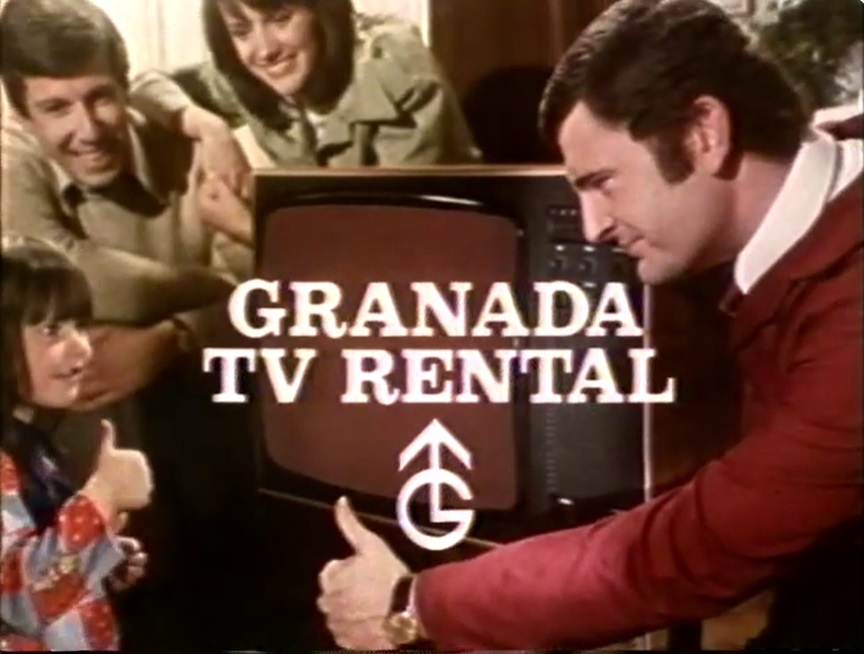
Object Name: Granada TV Rental commercial
Maker and Year: Granada Ltd.
Object Type: TV commercial
Image Source: https://www.youtube.com/watch?v=Yc3ZoxJ3yYs
Description: (Richard McKenna)
This 1977 TV commercial for Granada TV Rental opens a window onto an almost forgotten aspect of the relationship the British viewing public once enjoyed with their television sets. Despite having evolved in parallel with that of our counterparts across the Atlantic, it was a relationship with some important differences, the first of which was scale: until the arrival of Channel 4 in November of 1982, the British public enjoyed a wealth of exactly three channels—BBC1, BBC2, and ITV—none of which broadcast for more than 15 hours a day, much of which was programming for schools or for the Open University. Programming would usually start at 9:30 or 10:00 am, and the latest-running channel would usually wind up at around midnight with the weather forecast and (in England) the playing of the national anthem “God Save the Queen.” During the day there were also frequent off-air periods when vaguely disconcerting “test cards” would be shown while various flavors of easy-listening music played. Any child lucky enough to be off school sick was condemned to hours of staring at a desolate photo of a little girl sitting by a blackboard while they waited for even something as stultifying as magazine show Pebble Mill to brighten up the dread hours before the brief window of children’s programming began after three o’clock. Compare this to the situation in the US, where the average family probably had seven or eight channels broadcasting for 20-plus hours a day.
Brits were also subject to payment of the television license fee that funded BBC1 and BBC2—though not the independent ITV—which in the late ‘70s came in at around £12 (about £60 in modern day prices) for a black and white set, and £34 for a color set (£167). The fact that all Brits forked out was ensured by the BBC’s fleet of intimidating and 100%-not-a-psy-op “TV Detector Vans,” which prowled the streets of the country, allegedly carrying cutting-edge technology able to identify from a distance the freeloaders who balked at coughing up for what was admittedly a pretty good lineup, though probably just knocking on the doors of houses they knew hadn’t paid and trying to scare the owners into admitting they were watching snooker or darts at the expense of their fellow citizens.
And along with this limited access and door-to-door fee hassling, there was also the question of physical ownership of the TV itself. As unlikely as it seems from the perspective of 2026, when not being the proprietor of some kind of screen would probably indicate that you were severely unwell, long into the 1980s the vast majority of British households did not own the TV sets in their homes. Seen in those frugal times as an unjustifiably large outlay for something you would be lumbered with in the event of breakdowns or the vast-box technology progressing, TV sets—and later video recorders, but also at various points radios and record players—were generally rented from one of the several chains and local shops that offered this service. And while this might sound like penury to the gilded American ear, it was a clear step up from the coin-operated TVs many working-class families had endured until not long before, and in some cases continued to.
One of the companies that dominated the TV rental market, particularly across the North of the UK, was Granada. The TVs that Granada rented were mainly branded as “Finlandia,” but were actually produced by a combo of Finnish brands: Salora, Nokia, and Finlux, as well as Japanese TV producer Sanyo. A color family TV set at the end of the 1970s could cost from £250 to £500, while rental was only a few pounds per week, included servicing and repairs, and meant that as soon as some cutting edge innovation—like a remote control attached to the TV via a cable—became available, the old set could be returned and the joys of modernity enjoyed for a small increase in the weekly rental fee.
Part of British conglomerate Granada Ltd., Granada’s origins lay in the chain of cinemas founded by Sidney Bernstein in the 1930s. As it had grown, the proudly populist Granada had spawned a chain of motorway service stations that targeted the average-income traveler as opposed to sportscar-driving posh snoots, bingo halls, and several publishing houses including Mayflower, Panther, and Granada. It was also the independent television franchisee for the North West of England and the Isle of Man and contributed programming to the national ITV service.
Despite Bernstein’s Southern origins (he was born in Essex), Granada had a rep for Northern pugnaciousness and innovation, and this was nowhere clearer than in the TV the company produced, which became famous for groundbreaking neo-realist soap operas set in working class Manchester Coronation Street (the first episode of which was broadcast in 1960 and which continues today, though the neo-realism and groundbreaking-ness have long since abandoned the show’s moldering corpse) and documentaries like Seven Up!, part of the documentary series World in Action, as well as (very briefly) music show So It Goes. Presented by Factory Records founder and “biggest cunt in Manchester” Tony Wilson, So It Goes featured many of the era’s defining music acts, often making their first TV appearances. Guests included the Sex Pistols, Patti Smith, Buzzcocks, The Stranglers, and Siouxsie and the Banshees, before the show was cancelled after Iggy Pop proved too foul-mouthed even for flinty Granada execs.
The aggressively un-glamorous mood of the commercial, featuring the “slimline Finlandia Sensamatic” range with its “sharp natural Granada color”—another psy-op—and “touch channel change” captures perfectly the modest expectations of the British TV-viewing public, expectations that seem even more modest when contrasted with what was happening in the US at the same time, where companies like RCA and Zenith were providing American homes with sets that were operating at that particularly odd intersection of cutting-edge consumer technology and heavy duty carpentry.


