By K.E. Roberts / September 29, 2026

From the cover of Dianetics, 2007 edition
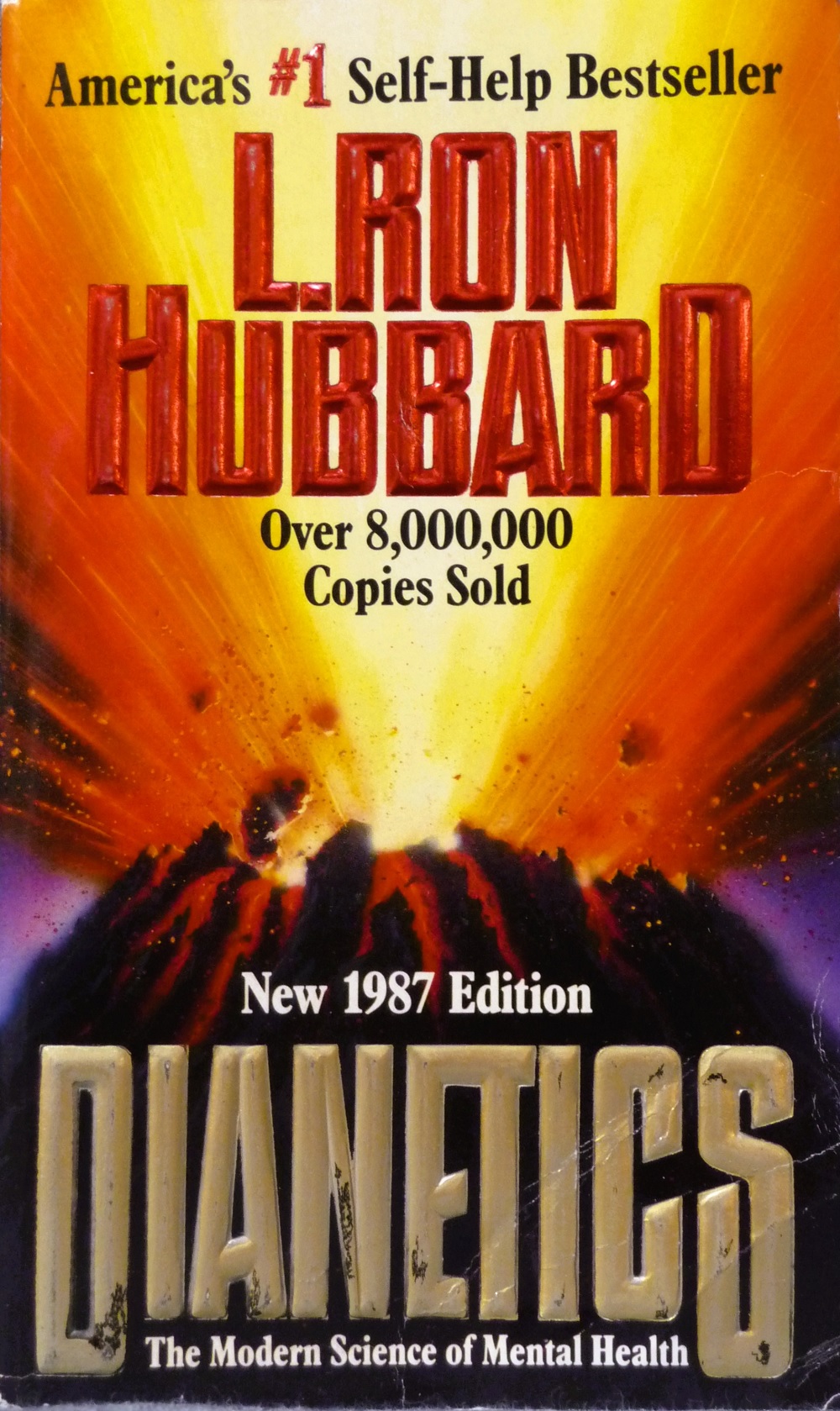
Anyone who was watching TV in the late 1980s remembers the commercial: probing personal questions appear in white text on a black screen as a Tangerine Dream-esque synth riff pulsates in the background. ”How can you increase your mind’s potential?”; “Why is it so hard to just ‘be yourself’”; “Do you have to live with pain?” With each question, a page number appears in red on the bottom right. Then, the music climaxes abruptly in a shattering chord! An animated volcano erupts, spewing rocks and orange-yellow magma into the purple night sky! The blazing volcano seamlessly becomes the front cover of L. Ron Hubbard’s Dianetics. A voiceover tells us that we can buy the book “wherever paperbacks are sold,” and then concludes, with “Dianetics” spelled out in big white block letters: “A fresh look at today’s problems.”
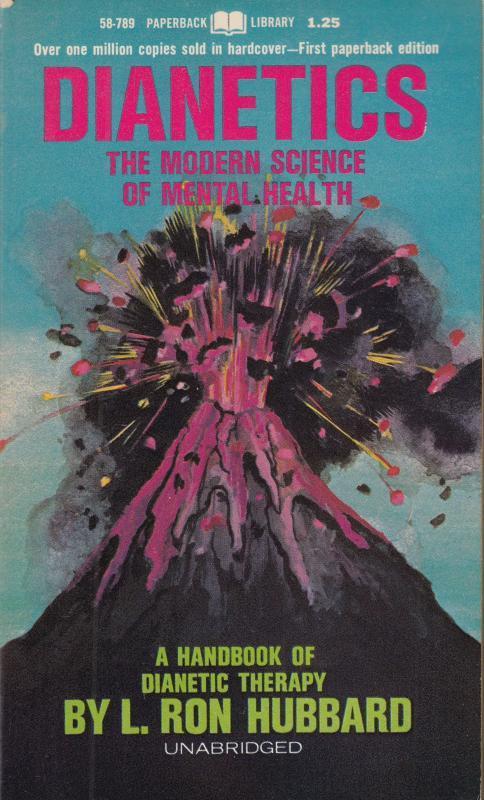
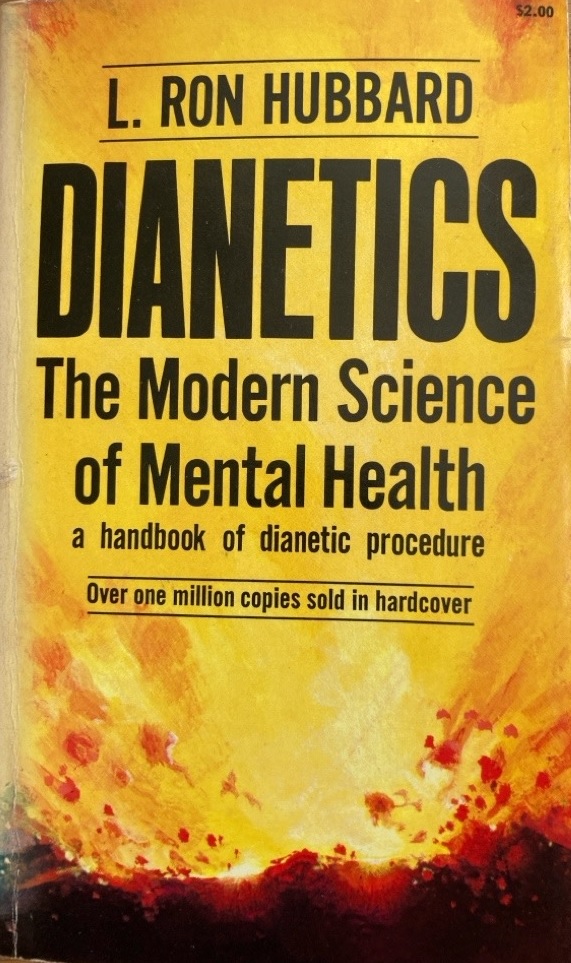
The commercials were part of an “unprecedented” multi-million dollar marketing blitz that started in the early ‘80s and included, in addition to ubiquitous TV time, print ads, neon signs, billboards, bus stop and subway station posters, radio spots, sponsorships, and banners at popular sports and entertainment venues. Dianetics, originally published in 1950, was and is the self-help cornerstone of the Church of Scientology, and was so sacrosanct to Hubbard that it marks, in some sense, the beginning of time: the years after publication of the first edition are referred to as AD, “After Dianetics” (1951 is 1 AD, and so on). Although exploding volcano imagery had appeared on the cover of paperback editions since 1968, the volcano-themed commercials didn’t air until 1987, coinciding with the release of a new edition; Dianetics soon after hit the New York Times Best Seller list (alongside Trump: The Art of the Deal) for the first time since 1950.
-

- 1968 edition
-

- 1973 edition
-
- 1987 edition
According to an interview in the Portland Mercury, the commercials were the brainchild of Jefferson Hawkins, who was put in charge of the Church’s marketing efforts by Hubbard himself in 1971. Shortly after Hubbard’s death in 1986, Hawkins alleges that he was systematically emotionally and physically abused by newly appointed leader David Miscavige, and was subsequently “offloaded” from the Church several times before he decided to quit. (Scientology officials dispute this story, and deny that Hawkins was responsible for designing the commercials.) The volcano image comes from Scientology’s story of Xenu, an evil space alien who, 75 million years ago, froze and kidnapped billions of citizens from his Galactic Confederacy and brought them to Earth, where he scattered them around volcanoes and blew them up with nuclear bombs. The spirits of the dead attached themselves to the survivors, causing psychological distress that was passed down to humanity and can only be cured through methods developed by the Church. Says Hawkins:
Splashing the volcano at them was supposed to hypnotize people back, or what they call ‘key them in’ to the whole Xenu incident… And then they would be somehow hypnotized to go and buy the book.
There’s no mention of the underlying sexual connotations: that rhythmic, building score (composed by Geoff Levin, a former high-level Scientologist) and all of those piling, pent up frustrations and anxieties and doubts—powerfully ejected in a hot, streaming orgasm of the mind! Sex sells, even when disguised as magmatic eruption.
 The colorful repackaging of Dianetics for the ‘80s consumer was part of the larger consolidation and commercialization of the self-help industry throughout the decade. You Can Heal Your Life (1984) by Louise Hay, Unlimited Power (1986) by Tony Robbins, Feel the Fear and Do It Anyway (1987) by Susan Jeffers, and The 7 Habits of Highly Effective People (1989) by Stephen Covey were all bestsellers that channeled the ethos of Ronald Reagan: government at all levels “destroys” individual initiative, and we must choose “self-reliance… the very substance of moral fiber.” It was pertinent advice, given the Reagan administration’s repeal of the Mental Health Systems Act of 1980 and cuts to social services that left communities without the means to treat their vulnerable populations. Most people who struggled with mental health couldn’t afford private therapy or psychiatric care, which was “two to three times the cost” of skyrocketing primary health care. But they could afford a $4.95 paperback—which, for the true believers inspired to rustle up (or borrow unto debt) the requisite cash, might turn into regular “auditing” sessions, memberships, extension courses, workshops, seminars, and $500-24-cassette-tape-30-day-programs that promised to fully unleash your “personal power.”
Dianetics as a “science of mental health” is extremely similar to psychoanalysis, which dominated the fields of psychology and psychiatry at the outset of the 1950s, when Hubbard’s book was first published. The difference would become another hallmark of the age of Reagan: a distrust and even disdain of academia and elitist “experts,” and a staunch attitude of anti-intellectualism (though by today’s pitiful standards, Hubbard’s text is probably just as impenetrable to most as the works of Sigmund Freud). This is from the Dianetics introduction, unchanged between the 1950 and 1987 editions:
This volume has made no effort to use resounding or thunderous phrases, frowning polysyllables or professorial detachment…
‘Basic language’ has been used, much of the nomenclature is colloquial; the pedantic has not only not been employed, it has also been ignored. The volume communicates to several strata of life and professions; the favorite nomenclatures of none have been observed since such a usage would impede the understanding of others.
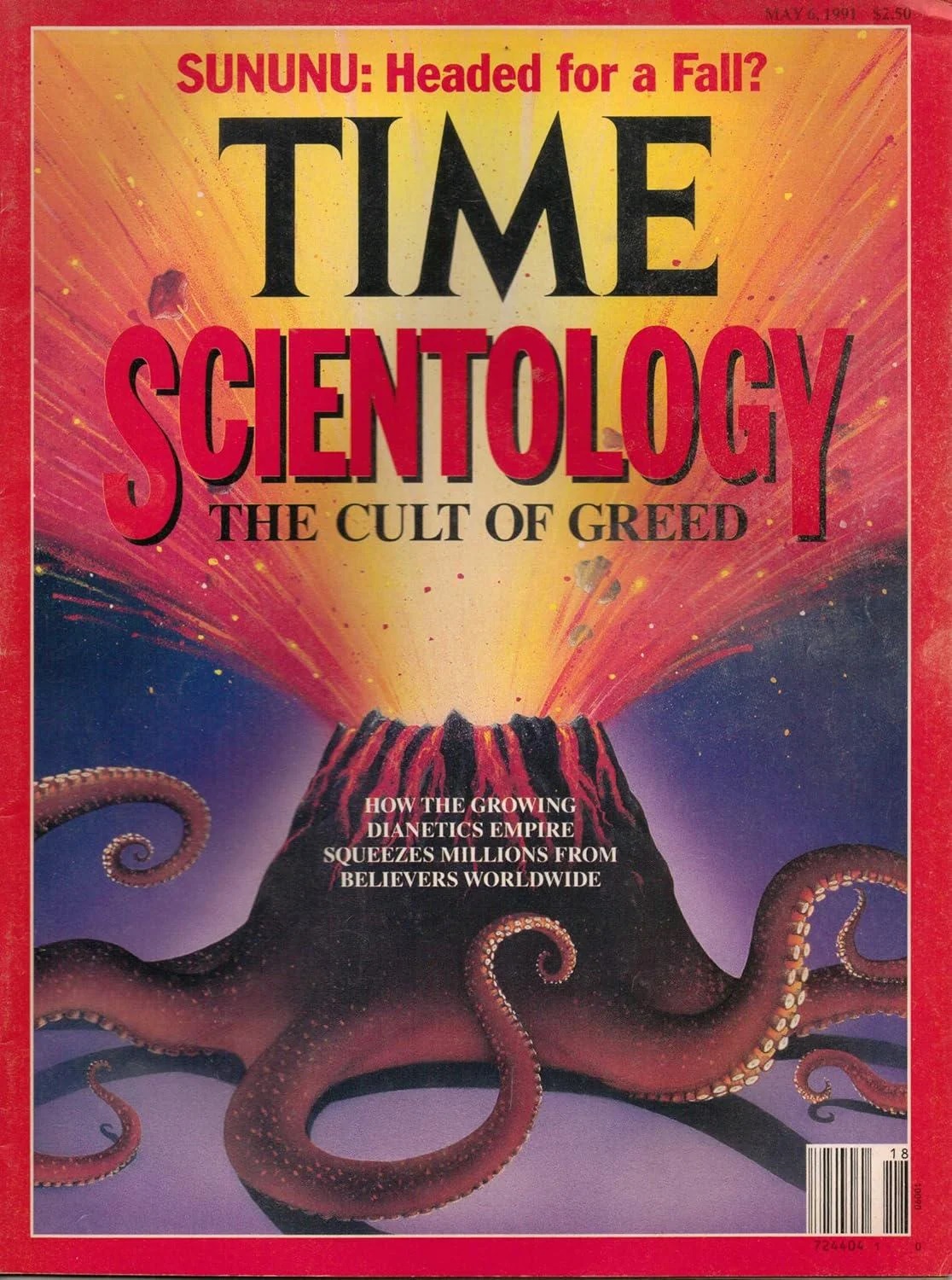
Whatever your feelings about self-help, psychiatry, or Scientology, the volcano commercials—and the corresponding array of paperback covers—are a masterclass in marketing, and the incandescent volcano continues to be the central visual motif in Dianetics advertising (see, for instance, the Dianetics Cybertruck hauling this mountainous billboard down Sunset Blvd. in 2025). It was so distinctive and recognizable following the deluge of commercials in the late ’80s that Time magazine used one—an exploding volcano that grows grasping tentacles for roots—for the cover of a 1991 issue featuring Richard Behar’s now-famous exposé of Scientology called “The Thriving Cult of Greed and Power.”
How long did those commercials run, anyway? Well into the 2000s, I knew. As I was trying to pin it down exactly, I was served this ad on my Facebook feed. It’s the same commercial, slickly updated for the terminally online, compulsively catastrophizing age: ‘What triggers anxiety without you knowing”; “How does your mind make your body sick?”; “Can you rebuild your mental health?” Answers on pages 95, 113, and 183, respectively. Insurance not required.
 K.E. Roberts is Editor-in-Chief of We Are the Mutants and a freelance writer. He lives in Los Angeles and will never own a house.


