‘Mysterious Monuments’ on the Moon, 1966

The first spacecraft to land on the Moon and transmit photographs back to Earth was Russia’s Luna 9, launched on January 31, 1966. It landed in the Ocean of Storms on February 3, and sent the first of nine images of the Moon’s surface seven hours later. One of these photos, according to an Argosy article by Ivan T. Sanderson from 1970, showed what appeared to be “two straight lines of equidistant stones that look like the markers along an airport runway…”
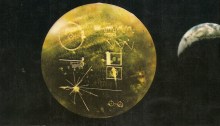
‘Murmurs of Earth: The Voyager Interstellar Record’, 1978

Murmurs of Earth was published the year after the 1977 launch of the twin space probes Voyager 1 and Voyager 2. While the Voyager program’s primary mission was to survey, photograph, and analyze the planets of the outer solar system, the book focuses on our attempts to communicate with whatever intelligent entities might encounter the probes as they flew headlong into the interstellar night…

Major Matt Mason: Mattel’s Man in Space, 1966 – 1970

The Matt Mason line was developed by Mattel to compete against Hasbro’s G.I. Joe, which debuted in 1964 along with the the descriptor “action figure”—the social reality of the day dictated that boys would not and should not play with “dolls.” While the “Joes” were 12″ tall, Matt Mason and his “space buddies” were reduced to 6″, a brilliant decision by Mattel…

TI-99/4A Computer Books, 1983 – 1987

Texas Instruments (TI), which had pioneered both pocket calculators and speech synthesizer technology in the 1970s, released its TI-99/4A home computer in 1981. After the release of its first personal computer, 1979’s TI-99/4—a fairly substantial commercial disaster—TI went back to the drawing board to produce a home computer that was cheaper, easier to use…

Photon Instructional Video, 1986

In 1984, an entertainment center was opened in the Dallas suburb of Garland that aimed to bring the futuristic imagery and technological thrills of space opera warfare into the real world: it was called Photon, a laser tag game in which two teams fought one another in a bloodless, computer-controlled simulation set in a multi-level arena filled with dry ice and lit by strobe lights…

Continental Airlines Commercial, Circa 1976

Prior to the Airline Deregulation Act of 1978, the fares, routes, schedules, and establishment of commercial airliners were controlled by the federal Civil Aeronautics Board (CAB). While regulation meant smaller profits for the airliners, it also meant guaranteed profits: the result amounted to a monopoly that was “too big to fail.” The supposed “golden age” of air travel, as depicted in the commercial above, was actually the result of so many half-empty planes in the sky…

Fiat “Handbuilt by Robots” Commercial, 1978

In the post-Star Wars era of 1978, robots—or “‘droids”—had ceased to be the ambiguous, threatening machines of yore. Now, they were cheerful helpmates for humanity who labored tirelessly (and free of cost) for the benefit of all. In a world suddenly obsessed with futuristic technologies, their appearance in an advertisement was sure to be noticed—especially by the younger members of any potential car-buying family…

K-tel Music Compilation Commercials, 1970 – 1984

Television advertising in the 1950s took a fairly staid and classic form: the advertising agency would spend 30 to 60 seconds presenting a domestic problem that its client’s product promised to alleviate. But the dawn of the 1960s introduced a more aggressive, hard-sell type of direct advertising, where the product’s manufacturer would sell a product directly to the TV viewer through product demonstrations…