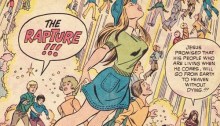
The Illustrated Rapture: ‘There’s a New World Coming’, 1974

Hal Lindsey’s bestselling The Late, Great Planet Earth, originally published by the Zondervan Corporation in 1970, revolutionized the Christian publishing industry and introduced the mainstream to rapture or “end times” terminology and imagery, which took root in America with Puritan settlers Increase and Cotton Mather. It was the first Christian book to be reprinted by a major publisher—Bantam, in 1973—directly after the Bantam edition of Chariots of the Gods? became a phenomenon…

The Surreal Within the Everyday: Jim Woodring’s ‘Frank’

Set in a world called “the Unifactor,” Jim Woodring’s wordless Frank recounts the adventures of the title character—a gormless-looking, anthropomorphic, rabbit-like creature with a nature by turns passive and perverse—and his interactions with the Unifactor’s other inhabitants and the world’s beautiful and frightening flora and fauna, given to unpredictable reactions and behaviors…

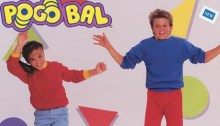
Pogo Bal Commercial, Circa 1987

Hasbro’s Pogo Bal made a splash in the States during the summer of 1987, becoming the third bestselling toy on the market after G.I. Joe: A Real American Hero (also Hasbro) and Barbie. Invented in 1969 by two Belgians, Raphael J. Van Der Cleyen and Wilfried F. Ribbens, the updated pogo stick became “immensely popular” in Europe during 1985, where it was sold as “Lolo Ball” or “Lolobal.” Hasbro acquired the rights soon after…

“The World’s Great Animals Come to Life”: Safari Cards, 1976 – 1986

Safari Cards were an English translation of a set of collectible zoological information facts first devised and published in Switzerland. Original publisher Éditions Rencontre in Lausanne, Switzerland specialized in subscription encyclopedias and other educational toys in the 1950s and ’60s. Intended explicitly from the very beginning to democratize learning and bring the classics of French-language literature to the public…

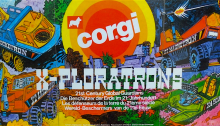
“21st Century Global Guardians”: Corgi’s X-Ploratrons, 1979

Billed as “global guardians,” the X-Ploratrons were four toy vehicles, each equipped with its own novelty tool—mirror, magnifying glass, compass, and magnet—and charged with protecting humanity in the “fictitious disaster-wrecked world of the 21st century,” where “the elements rebel against man!” They were long-established die-cast toy brand Corgi’s attempt to adapt to the wave of SF-driven commerce that followed the unprecedented success of Star Wars…

Diaclone Television Commercials, 1980 – 1984

Having become an aficionado of YouTube compilations of television commercials from the ’70s and ’80s, being introduced to this particular collection was a real treat. And such an uncanny one! Here are the Transformers I played with as a kid—Optimus Prime, Wheeljack, Ratchet, Sideswipe—in their original context as members of the Diaclone (ダイアクロン Daiakuron) line of toys from Japan…

Sorry No Gas: Photos from Documerica, 1972 – 1975

At the dawning of the 1970s, Americans were more aware than ever of the great damage more than a century of unrestricted industry had done to their country. With the passing of Richard Nixon’s Reorganization Plan Number 3 by Congress in 1970, the U.S. government welcomed the Environmental Protection Agency to the roster of federal agencies. The EPA was meant to consolidate federal efforts to protect America’s air, water, and soil, and to give environmental protection efforts a fiercer executive independence…

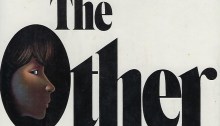
Paul Bacon Cover Gallery, 1952 – 1983

After serving in the Marines during World War II, self-taught artist and typographer Paul Bacon (1923-2015) landed in New York City, where he designed several now-famous album covers for jazz labels Blue Note and Riverside Records. Bacon had discovered jazz in the ’30s, and he remained a great fan—he was befriended by Thelonious Monk, among others—throughout his life…

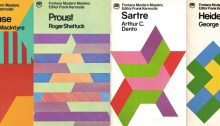
Fontana Modern Masters Cover Gallery, 1970 – 1984

The Fontana Modern Masters series was conceived in the late 1960s at Scottish publishers William Collins & Company’s Fontana imprint. Fontana Books had spent its first decade publishing inexpensive paperback pulp and detective fiction, priced between two and three shillings. But, in May 1968, revolutionary theory and Situationist praxis caught fire in the streets of Paris, as students plastered walls and barricades with catchy slogans meant to détourne the mainstream postwar advertising culture around which they’d grown up…