By Richard McKenna / August 10, 2026
Grimy, esoteric capital of the ‘80s North of England, post-Thatcherism Leeds was a peculiarly dual-natured place. An increasingly moribund industrial economy still haunted by the atrocities of the Yorkshire Ripper and a city that had torn up its Victorian tram lines and driven massive highways through its body, it felt as though it were lurching towards death’s door. Yet at the same time, in the hiatus before its eventual rebirth as the financial service hub, profit-driven-university town, and glistening shopping Mecca for new wealth of the new millennium, there was strange life teeming in the ailing body.
Certified home of goth and breeding ground for bands of all types, Leeds had what must have been one of the most vibrant youth and counterculture scenes in the UK at the time. Squatting was still legal, and the city’s abundance of empty terraced houses abandoned by their absentee landlords—who owned dozens of properties that they left to rot rather than pay for them to be made habitable—meant that enterprising kids could find a place to stay and neighbors who were often relieved (admittedly to varying degrees) that someone was at least there to stop next door’s roof from falling in. And back then, students in the UK were still given grants to pay for their education and accommodation, meaning young people from all economic backgrounds could go to whatever university would accept them, wherever in the country that happened to be.
What this translated to was a town that was riddled with subcultures: hippies, goths, grebos, punks, soul boys, rockers, metallers, politicos, anarchos, even the occasional mummified ted. In contemporary terms, we’d probably say that Leeds was in the early stages of being gentrified, and most of the people doing what would become known as gentrifying (back before the British property market reached the levels of malignancy it enjoys today) were pretty normal types just trying to do their own thing and live on the cheap, as opposed to vibe vampires leeching out some commodified atmosphere of coolness. Especially because, cool as it genuinely was, Leeds wasn’t cool cool: the place was grotty enough to defy belief.
As a child of the distant marshes, my first solo visits were to the city center’s impressive range of comic, music, and pawn shops, lodged in a heady mix of concrete monstrosities from the ‘70s and soot-blackened remnants of its 19th century glory days. My first visits as a nominal adult, meanwhile, were to two northern legends: first, underground (literally, fire regulations be fucked) and allegedly-world-first goth club The Phono, situated Tardis-like at the bottom of a flight of stairs under a staircase in shopping mecca The Merrion Centre (a then-thriving Logan’s Run-like environment whose uncanny little “Georgian Arcade” may have provided the UK with its first dead mall). And second, The Duchess of York, a pub whose frenzied roster of bands, playing practically every day of the week, meant that on a random night you might encounter artists as varied as Wilko Johnson, Fugazi, Little Chief, Eddie and the Hot Rods, The Fuzztones, and Christian Death, as well as inevitable perennials Dumpy’s Rusty Nuts and Zoot and the Roots.
 As my involvement in the punk scene grew, more by capillary action than by my own feeble initiative, I started getting marched (car-owning punks being a rare breed in the UK) to squats and flats further outside the city center. Many of these journeys seemed to involve passing through a large junction called Hyde Park Corner, which also lent its name to the nearby park. Officially named Woodhouse Moor, Hyde Park was the location of many of the city’s “punk picnics,” one of which in 1988 was infamously broken up by the cool-headed and professional Leeds constabulary using their famously gentle policing methods. Hyde Park corner was where I, like many others, was pointed towards my first ever face-to-face encounter with The Occult. Not that the occult in this case needed much pointing, as the entire ground floor of the occult’s premises on the corner of the Crescent, a curving row of three-story Edwardian shops, was painted a disconcerting Cadmium yellow—remember that color—and had the words “ASTONISHING BOOKS” in two-foot–high black block capitals on the fascia.
The first time I saw the Sorcerer’s Apprentice—subsequently S.A.—would have been 1987, the year of the Hungerford massacre, where 16 people were shot dead, and when allegations of Satanic ritual abuse were starting to make waves in Britain after two very widely reported cases in Nottingham and Cleveland: in both, large numbers of children were removed from their families on the basis of a later discredited abuse test. The shop would have already been in its tenth or eleventh year of trading and was a legend in the subculture of Leeds and the North, and even nationally. Founded in 1975 by Frater Marabas, alias Chris Bray (not to be confused with his namesake, Catholic speaker and winner of multiple Gospel Music Association Covenant awards), the S.A. billed itself as “one of the most influential dissemination points of The Ancient Wisdom in Europe in modern times.”
Despite a lifelong obsession with the weird, I was—and to some extent (approximately 100%) remain—a massive coward and worrier, so entering the S.A. for the first time took all of the miniscule amount of nerve I had at my disposal. Would I be instantly enrolled into Satanism? Sacrificed? Cursed? Possessed? Chris, however, turned out to be an almost aggressively gentle and welcoming storekeeper, and the racks of the S.A. covered all bases, from the most abstruse and intimidating Chaos Magick tracts to the kind of silly skull-shaped tack that was, frankly, more on my level. Despite this, though, the overwhelming feeling was that you were dealing with something serious. S.A. didn’t feel like a head shop or new-age bullshit peddler: there was a definite vibe—friendly, but not fucking around. I left with a stack of the catalogs and opuscules that Bray seemed to be able to generate in vast numbers, along with the banner of the sucker: a trade paperback of The Simon Necronomicon (in my defence, I had only recently emerged from my high Lovecraftian period, when I had “dressed like” HPL, i.e. worn loads of ill-fitting hand-me-downs and a hat, greasing my hair back with Brillo cream, or soap if I was short of cash), which, it should be noted, Bray made sure to underline was basically a fan novelty and not something to be taken seriously.
As a bred-in-the-bone dilettante, I unfortunately can’t make claims of any deep understanding of Magick, and my visits to the S.A. were mainly titillation, but it was clearly an important node for British occultism. It wasn’t until decades later that I realized the name of the bookshop was actually, natch, Astonishing Books, while the Sorcerer’s Apprentice was the name of the mail-order occult supplies shop Bray had founded in 1975 in another location in Leeds, an old cornershop with its windows boarded up and painted black in a way that evoked a sex shop, as Phil Hine, another member of West Yorkshire occult circles and co-founder of Pagan News, has pointed out. For years this shop hosted meetings and coffee mornings that were fundamental in the evolution of modern British, and international, occultism, and the scene that revolved around it included such occult luminaries as Ray Sherwin and the late Peter J. Carroll, whose seminal texts Psychonaut (1982) and Liber Null (1978) Sorcerer’s Apprentice Press respectively published and republished and were foundational for the first wave of Chaos Magick. I also learned that Bray was the publisher of The Lamp of Thoth (1982-1987?), a magazine I’d occasionally leafed through at people’s houses, and which covered the various permutations and directions of the occult/pagan scene with an energetic, fanzine-like approach. It also included a problem page and comic strips, most notably Dave Brown and Dave Lee’s Arthur Micklethwaite: Yorkshire Zen Master.
 Often when I went to or past the S.A., there would be the odd sad Christian fundamentalist with a megaphone standing across the busy road, loudly declaring that it was a den of iniquity and Bray a danger to the nation’s youth. Or, more worryingly, there would be one or two of Leeds’s famously brutal skinheads standing immobile and staring threateningly at the shop. But oddball religious nutters were hardly an oddity at the time, the ‘80s having seen a bit of a boom in activist Christians with groups like The Jesus Army on the march, and nor were scowling boneheads. The shadow of Mary Whitehouse and her campaigns against permissiveness and obscenity and all things strange stretched long across the public discourse. But in 1989, things took a more serious turn when Bray and the Sorcerer’s Apprentice became the subject of an episode of The Cook Report (1987-1999), a hugely popular investigative TV show presented by journalist Roger Cook.
Cook had made a name for his brand of vaguely performative confrontational (by the standards of the time) investigative reporting with Checkpoint (1973-1985), a BBC Radio 4 program that exposed criminals, con-men, injustice, and official incompetence. Cook was famous for taking on his targets face to face, and the threats of physical violence he often received became part of his schtick. The eye of the hurricane had been closing in on the S.A. at least since April of 1988, when “Falstaffian” Tory member of parliament and anti-pedophilia crusader Geoffrey Dickens had brought the shop up in a debate in the House of Commons. The vortex of public-enraging issues it could be associated with and its perceived (well, pretended) dangerousness made the shop a prime target for Cook’s approach. So, the 1989 episode “The Devil’s Work” of the The Cook Report sought to ride the wave of anguish and fear that had been mounting in the UK following the arrival from across the pond of the Satanic Panic.
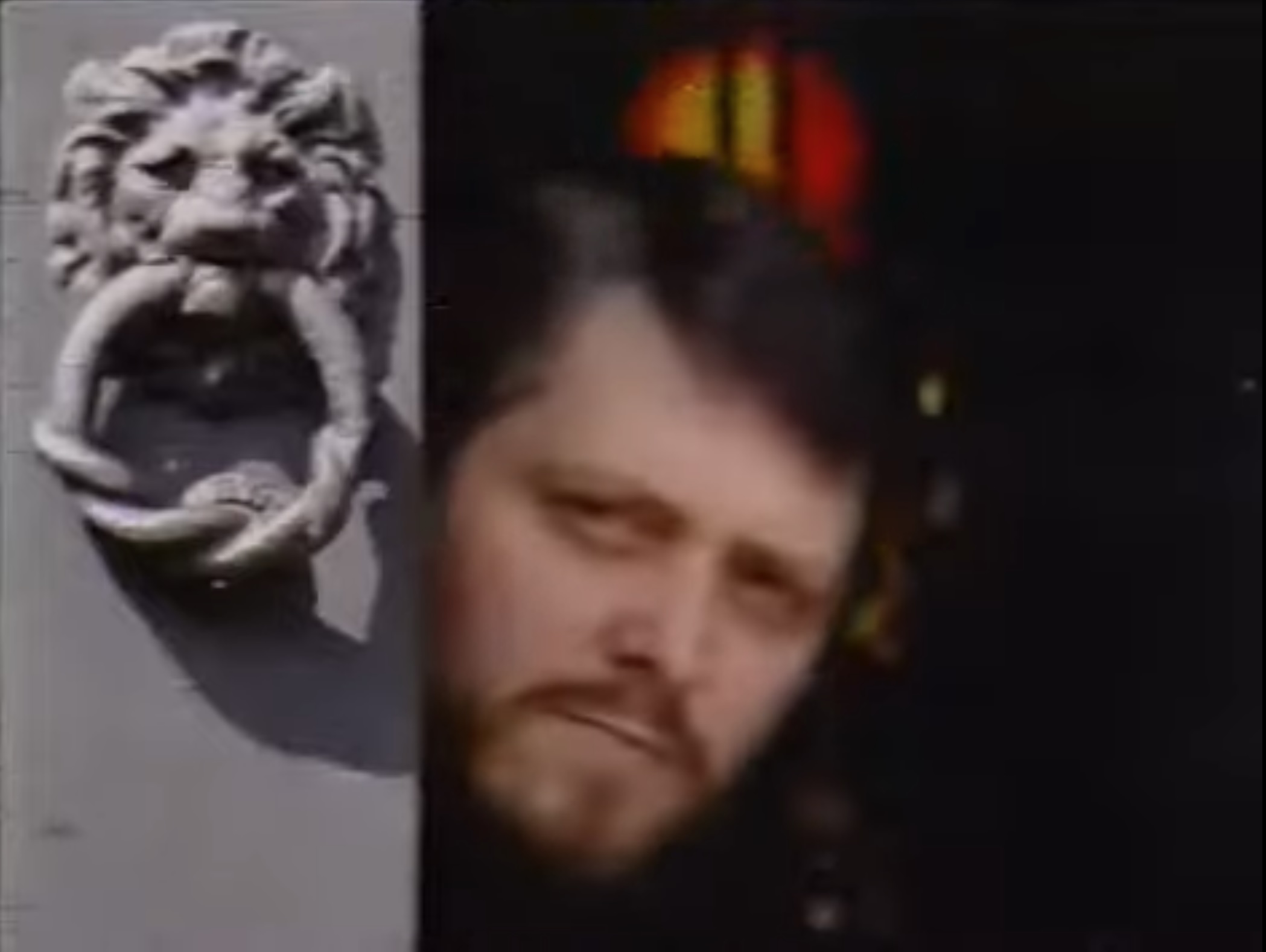
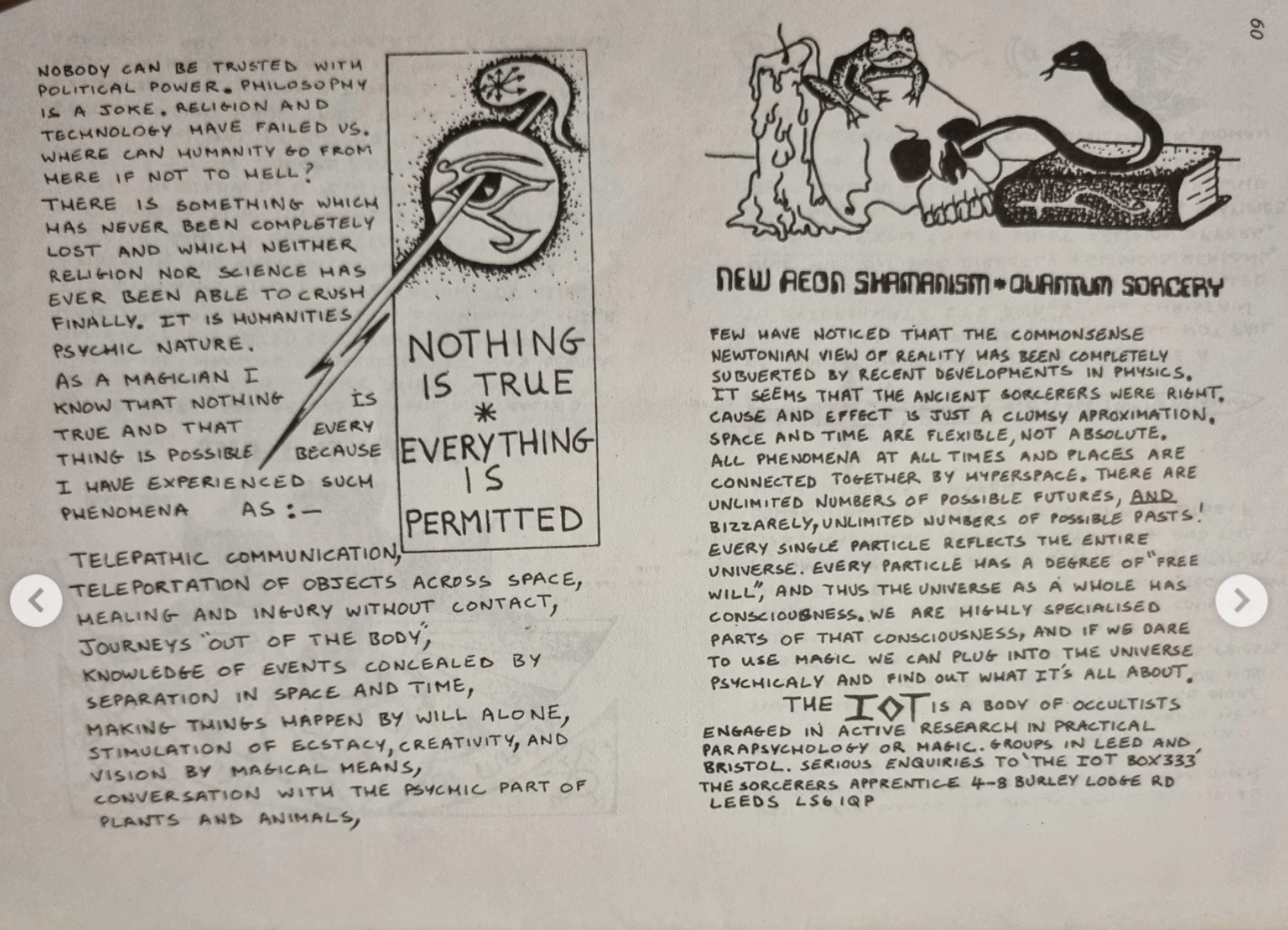
Having sensed that Cook planned to stitch him up, Bray refused the Cook Report production team’s requests for interviews and provided them only with a four-page manifesto of his beliefs, so they resorted to using footage recorded in 1986 for an episode of TV show “Central Weekend,” which gives a good idea of how charismatic and eloquent Bray was (at one point he’s shown using a Kaypro 10 PC, proof of his forward-looking attitude and, given its 1984 price of nearly $3,000, business acumen). More clips of Bray are featured in this featurette—presumably the work of the man himself, given the bold use of yellow—which also includes mind-bending scenes of Bray explaining the occult to Yorkshire TV legend Richard Whitely.
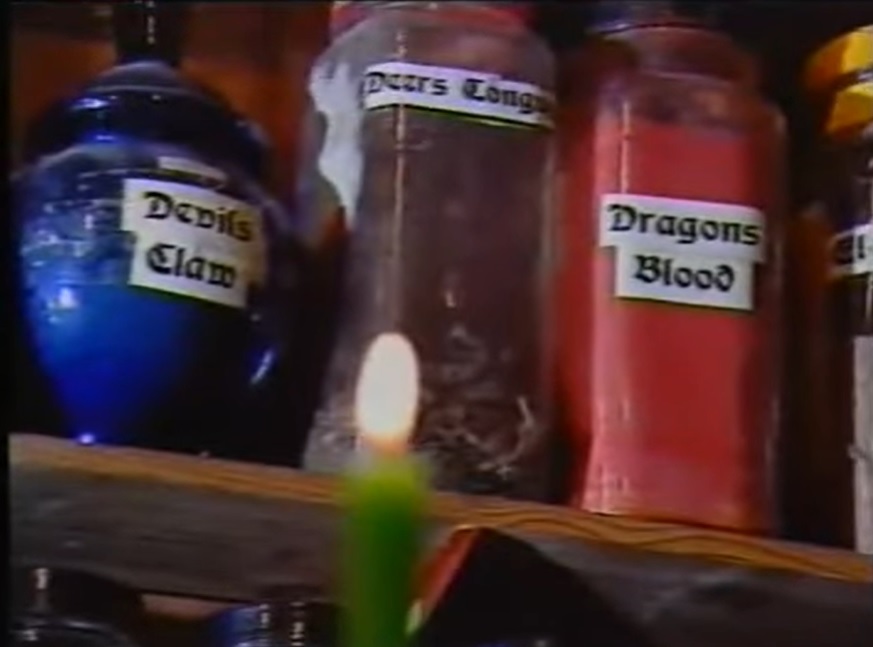 Despite featuring input from respected scholar of the occult Ozzy Osbourne, “The Devil’s Work”’ was a predictably scurrilous affair that, as Bray had predicted, attempted to paint him, the Sorcerer’s Apprentice, and the occultist and pagan communities as evasive, secretive, and somehow Satanist—and therefore ritual abuse—adjacent. It was funny, given Bray’s penchant for continually putting out communiqués stating very clearly what the S.A.’s beliefs were and what it was opposed to. Less than a month after “The Devil’s Work” was broadcast, somebody—Bray presumes fundamentalist Christians, which certainly seems possible, though one rumor had it that the skins were responsible—broke into the shop and made a bonfire of books on the floor in an attempt to burn the place down. Bray provides a characteristically detailed and yellow-leaning rundown of events here. A letter-writing campaign to the Broadcasting Complaints Commission resulted in an official complaint, and when the BCC subsequently found that The Cook Report had indulged in unfair dealing, the show was forced to issue an apology that was printed in listings magazine TV Times and broadcast on the independent channels.
Bray closed Astounding Books in the second half of the ‘90s, continuing with his mail order business from his other premises, and after a period as Belushi’s diner, L’Oranaise, Al Pacino’s Bistro, and various other student-cash-targeting businesses, the old corner shop is, as of 2026, a Greek “street food restaurant,” all of which is very much in line with Leeds’s current vocation as a cut-price London. The S.A. online shop—which takes up Bray’s memorably idiosyncratic visual approach and, yes, love of yellow—is still active, and may even still be trading; and a trip through its many pages is as illuminating as it is confusing, a similarly overwhelming experience to the various yellow-favoring Youtube channels and websites that Bray also maintains.
Understandably, outrage at the attempt to associate him with the most heinous and disgusting of crimes and set him up as a scapegoat for the ‘80s equivalent of right-wing ragebait clicks burns through in all of Bray’s writing on the series of events that, for a brief moment, put Yorkshire occultism in the national spotlight. And as the hands of the clock feel as though they’ve perhaps come full circle to a similar, though far more intense, configuration of cultural forces, this parochial (in the grand scheme of things, though certainly not to those involved) little disgrace seems oddly prescient of the world we now inhabit.
 Richard McKenna grew up in the visionary utopia of 1970s South Yorkshire and now ekes out a living among the crumbling ruins of Rome, from whence he dreams of being one day rescued by the Terran Trade Authority.


Hello Richard,
From Mickey K. here in Australia.
I was feeling nostalgic, as you do at my vast age, so thought to investigate Chris Bray’s old “S.A.”
I came across your article here and ruminated – “good God, this is from only last month!”.
So, decided to respond a thankful reply and let you know others must appreciate you posting these memories.
Indeed, I have my own fond memories of Chris Bray and his “Sorcerer’s Apprentice” 1980s mail-order service, being an avid customer during that glorious decade of occult dalliance.
Looking in my Archive I still have all his correspondence included with my Orders.
From which I have selected two images to share :
Examples of selected incense products in original packaging and a back-order advice notice dated June 1982.
This was all fabulous fun, back in our carefree youthful days…
Cheers,
M.C.Kelly, Esq.