
A Year in the Iso-Cubes: The Mutants Recap 2020
Christ on a bike, it has been a year. Who would have imagined back when we started 2020 with a frivolous piece on little plastic spacemen the grim turn things were about to take?
Christ on a bike, it has been a year. Who would have imagined back when we started 2020 with a frivolous piece on little plastic spacemen the grim turn things were about to take?

Apologies in advance to any fellow child of the UK who might be reading this, because for a Brit of my generation, choosing The House That Bled to Death as exemplar of British TV horror is a bit like announcing that your favorite novel is Moby Dick or your favorite food is pizza…

Stuff has to happen when it has to happen, I suppose. Back in the summer of 2018, I’d pre-ordered a copy of James Cawthorn: The Man and His Art, but by the time it was released, the family health issues that had been increasingly dominating my life over previous years had consumed it completely…

Sometimes it’s in ephemeral fragments of the culture that time travel lurks. We learn to tune out the looming monoliths of the zeitgeist the same way we learn to tune out the sky: its ubiquitousness would otherwise be oppressive…

Bear with me, because this might get a bit rambling: the way I see it, in a healthy world, not only would we have in hand the levers of the factories, we’d also have the tools for our own artistic fulfillment…

In 1977, with von Däniken mania still thriving, Alfred Górny of Polish publishing house Sport i Turystyka—Sport and Tourism—made an agreement with Econ Verlag, the publishers of the German edition of Chariots of the Gods?, to create a series of comics based around von Däniken’s crackpot concepts…
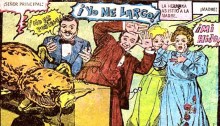
Most editions of Vidas Ilustres dealt purely with the biographical details of the person in question, but in the Obras Inmortales (“Immortal Works”) series the comic would dramatize not only their life but also a piece of their oeuvre. This was the case with “El Hombre Que Se Convirtirio En Un Insecto”—“The Man Who Became an Insect.”
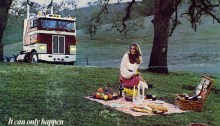
Heir to the role of freewheeling individualism once inhabited by the cowboy, over the course of the 1970s the truck driver grew to be an increasingly dominant figure in the American imagination…
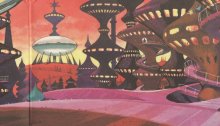
A favorite gift of British nanas, uncles and aunts of the 1970s, transfers—like coloring books—inhabit the deadening overlap between creativity and restriction. As liberating as they always looked while still in their packets, once out on the kitchen table, doing transfers frequently turned out to be a depressingly uninspiring activity. Not so Thomas Salter and Letraset’s Space Adventures…
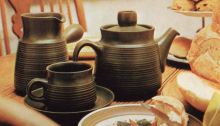
A strange talisman of British middle- and lower-middle-class aspirations of the 1960s and 1970s, Denbyware—the costly, absurdly heavy, hard-wearing (read, impossible to rid yourself of or destroy) brand of British tableware famed for its dun-colored hues, threatening shapes, and cranial-trauma patterns—was for a time the ne plus ultra of performative provincial socializing…

